The Orient Express: A Story That Began in 1883
The carriages which now make up the Venice Simplon-Orient-Express have each acquired their own history and special character over more than a century of travelling the rail lines of Europe. Together they represent one of the most extraordinary collections of surviving railway vehicles in the world.
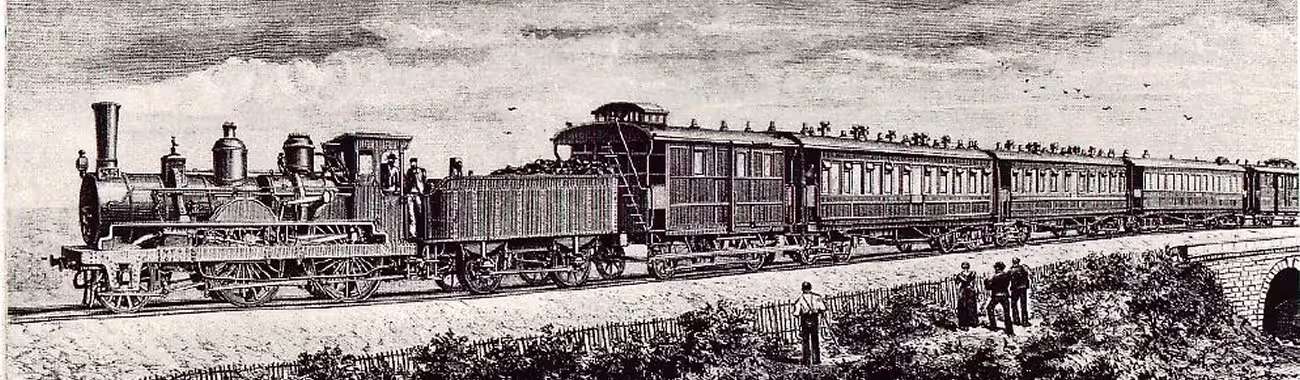
The Orient Express was created in 1883 by Compagnie Internationale des Wagons-Lits, founded by the Belgian railway entrepreneur Georges Nagelmackers. What began as a long-distance passenger service across Europe became, within a generation, the most celebrated train in the world: a byword for luxury, romance, intrigue and the glamour of international travel.
The Story Year by Year
George Mortimer Pullman and the Luxury Railway Car
The origins of luxury rail travel owe much to George Mortimer Pullman, an American entrepreneur who recognised that long-distance train travel could be transformed from an ordeal into an experience. In 1864 he designed and built his first sleeping car, the Pioneer, which set a new standard for comfort and craftsmanship. His cars featured inlaid woodwork, plush upholstery and attentive staff who served passengers throughout their journey. The idea that a train could be a destination in itself, rather than merely a means of reaching one, was Pullman's great contribution to travel.
Parlour Cars and Dining Come to the Continent
From the 1870s, parlour cars and sleeping carriages began to appear on British and continental rail services. Passengers on these trains were among the first in the world to enjoy meals served at their seat during a journey. In 1881 the Pullman Limited Express began operating an all-Pullman service between London and Brighton, and George Mortimer Pullman extended his vision by connecting train services with ferry crossings to offer through luxury travel between London and Paris. The concept of seamless, comfortable long-distance travel was taking shape.
Georges Nagelmackers and the First Orient Express
On 5 June 1883, the Express d'Orient made its inaugural departure from Paris Gare de Strasbourg. The train had been created by Georges Nagelmackers, a Belgian engineer and entrepreneur who had visited the United States, seen the Pullman cars at first hand and resolved to bring the concept of luxury rail travel to the European continent. Nagelmackers's Compagnie Internationale des Wagons-Lits built sleeping carriages and introduced the first restaurant cars to be offered on a continental train, serving elaborate meals prepared by trained chefs.
The initial service ran from Paris to Giurgiu in Romania, where passengers continued by ferry across the Danube to Varna in Bulgaria before boarding a steamer to Constantinople. It was neither quick nor entirely comfortable, but it was revolutionary. For the first time, travellers could make the journey from Paris to the Ottoman capital in relative luxury rather than enduring the rough and often dangerous overland routes that had preceded it.
The All-Rail Route to Constantinople
By 1889 the railway lines had been extended sufficiently to allow the Orient Express to run entirely by rail from Paris to Constantinople, eliminating the ferry and steamer sections of the original route. The journey time was dramatically reduced and the service became genuinely viable for the growing number of diplomats, merchants and wealthy travellers who needed to move between western Europe and the Ottoman capital. This was also the year in which the novelist Bram Stoker, inspired by stories of the train, began researching the book that would eventually become Dracula, with the Orient Express playing a role in the early chapters.
The Simplon Tunnel Opens
The completion of the Simplon Tunnel in 1906 was a pivotal moment in the history of European rail travel. At the time it was the longest railway tunnel in the world, running for nearly 20 kilometres beneath the Alps to connect Switzerland directly to Italy. For the Orient Express, the tunnel opened up an entirely new southern route that would eventually become the Simplon-Orient-Express, passing through Milan, Venice and Trieste on its way east. The journey time between Paris and Venice was drastically reduced, and a new chapter in the train's history began.
The Golden Age of the Orient Express
The period between the two world wars represented the absolute peak of the Orient Express's prestige. The Simplon-Orient-Express was introduced in 1919 following the opening of the Simplon Tunnel, running from Paris through Milan and Venice to Constantinople. The carriages of this era were masterpieces of the Art Deco movement: polished marquetry, Lalique glass panels, lacquered wood, monogrammed silverware and fine linen. The train carried royalty, diplomats, film stars, writers and spies with equal discretion.
It was during this period that the Orient Express acquired the mythology that still surrounds it today. The Roaring Twenties and the glamorous 1930s gave the train a cast of passengers whose stories seemed almost too dramatic to be true, and in many cases were. The train carried King Boris III of Bulgaria, the Aga Khan, Mata Hari and countless others whose journeys across Europe were freighted with consequence. The author Agatha Christie travelled on the train and used it as the setting for what became her most celebrated novel.
Agatha Christie and Murder on the Orient Express
When Agatha Christie published Murder on the Orient Express in 1934, the train was already the most famous in the world. Christie had herself been a passenger on the Simplon-Orient-Express and used the setting with great precision: the specific layout of the carriages, the dining car, the cabin arrangements and the cast of passengers drawn from across Europe and America. The novel made the train synonymous in the popular imagination with mystery, glamour and international intrigue, an association that has never entirely faded. Hercule Poirot, Christie's Belgian detective, would return to the Orient Express in later stories, cementing the connection between the fictional detective and the real train.
The Second World War Brings the Service to an End
The outbreak of the Second World War in 1939 brought the Orient Express to an abrupt halt. Frontiers across Europe were closed, ferry services cancelled and the train was requisitioned for military use. The carriages that had carried kings and celebrities were pressed into very different service. For six years the luxury rail network that Nagelmackers had built was dismantled by conflict, and when the war ended in 1945 the post-war division of Europe into western and Soviet spheres made a return to the pre-war routes impossible for many years.
The Decline of the Golden Age
The post-war decades were difficult ones for the Orient Express. The rise of commercial aviation offered passengers the option of reaching their destination in hours rather than days, and the economics of luxury rail travel became increasingly hard to justify. The routes were gradually curtailed, the service frequencies reduced and the standard of the carriages allowed to decline. The train limped on through the 1960s and into the 1970s in a much diminished state, operating on restricted routes with a fraction of its former frequency. The last direct service from Paris to Istanbul departed in 1977, ending what remained of the original route.
The Carriages Are Auctioned at Sotheby's
When the Orient Express service finally ceased in 1977, the historic carriages were sold at a Sotheby's auction held in Monte Carlo. They were dispersed across Europe, some converted into restaurants, others left to decay in sidings, and a handful purchased by collectors and railway enthusiasts. It seemed at the time that the story of the Orient Express was definitively over. Two of the carriages were purchased by an American millionaire and entrepreneur named James B. Sherwood, who had a different idea about what their future might hold.
James Sherwood and the Great Restoration
James Sherwood, who had built the Sea Containers shipping company into a major international business, spent several years tracking down and purchasing 35 of the original Compagnie Internationale des Wagons-Lits carriages from the 1920s and 1930s. The carriages were in varying states of condition: some had been converted and required stripping back, others had simply been neglected and needed extensive structural and cosmetic restoration.
The restoration programme was undertaken with exceptional care and at considerable expense. Craftsmen were commissioned to recreate the original marquetry panels, the Lalique glass details and the bespoke fittings that had defined the carriages in their golden age. Period fabrics and wallcoverings were researched and reproduced. The original silverware and china patterns were tracked down and, where originals could not be found, faithfully replicated. The result, when the restoration was finally complete, was a collection of carriages that looked as they had in the 1930s but incorporated discreet improvements in safety, reliability and comfort.
The Venice Simplon-Orient-Express is Reborn
On 25 May 1982, the Venice Simplon-Orient-Express made its inaugural journey from London Victoria to Venice. The train was an immediate sensation. The combination of authentic original carriages, impeccable service, exceptional food and the romance of the route captured something that had been absent from European travel since before the war. The passengers on that first journey included journalists, travel writers, celebrities and enthusiasts from around the world, and the coverage that followed established the revived train as one of the great luxury travel experiences of the modern era.
The route from London used the British Pullman, a rake of British carriages, to cross England before passengers boarded the continental carriages at Folkestone or Dover for the Channel crossing and the onward journey through France, Switzerland and into Italy. Since 2007 the Channel Tunnel has changed the logistics of the crossing, and today's service departs from Paris, where passengers join the iconic dark blue continental carriages for the journey south to Venice and beyond.
The Legend Continues
The Venice Simplon-Orient-Express today operates from Paris to Venice, Istanbul, Prague, Budapest, Vienna and other European destinations from March to November each year. It is now part of the Belmond collection of luxury travel experiences. The carriages continue to be meticulously maintained and periodically updated with new design commissions, including the addition of Grand Suites and the extraordinary L'Observatoire carriage, while the fundamental character of the train, its original Art Deco interiors, its attentive personal service and its incomparable atmosphere, remains unchanged.
More than 140 years after Georges Nagelmackers first dispatched a train from Paris towards Constantinople, the Orient Express remains the most celebrated and most imitated train in the world. There has never been quite anything like it, and nothing else has come close to replacing it.
In an age that too often reduces travel to the speed and efficiency of getting you to your destination, the experience of this journey is more alluring than ever.
Venice Simplon-Orient-ExpressNotable Passengers Through the Ages
The Orient Express carried some of the most significant figures of the 19th and 20th centuries across Europe. Its passenger lists, had they been made public, would have read like a directory of the great and the powerful of their age. Among those who travelled on the original Orient Express and its successors were:
Agatha Christie
The crime writer was a regular passenger on the Simplon-Orient-Express and used the train as the setting for Murder on the Orient Express in 1934, the novel that cemented the train's place in popular mythology and introduced Hercule Poirot to the carriages.
King Boris III of Bulgaria
A passionate railway enthusiast, King Boris was known to occasionally take the controls of the Orient Express locomotive as it passed through his kingdom. His enthusiasm for the train was genuine and well documented by railway staff of the period.
Graham Greene
The novelist travelled on the Orient Express and used it as the basis for his 1932 novel Stamboul Train, published in the United States as Orient Express. Greene's account captured the mixture of characters and intrigues that made the train such fertile ground for fiction.
Mata Hari
The Dutch exotic dancer and alleged spy used the Orient Express routes as part of her movements across wartime Europe. Her journeys on the train became part of the mythology of espionage that surrounded the service during the First World War.
Lawrence of Arabia
T.E. Lawrence, who fought against the Ottoman railway network during the First World War, was also a passenger on the peacetime Orient Express. The irony of the man who had spent years destroying Turkish trains travelling to Istanbul in luxury was not lost on contemporary observers.
The Aga Khan
The religious leader and statesman was a regular and enthusiastic passenger on the Orient Express during its golden age. His presence on board was invariably noted by other passengers and added to the train's reputation as the preferred transport of the world's elite.
Key Dates in Orient Express History
- 1883First Orient Express departure, Paris to Giurgiu in Romania
- 1889First all-rail service, Paris to Constantinople
- 1906Simplon Tunnel opens, creating the southern Alpine route
- 1919Simplon-Orient-Express introduced via Venice
- 1934Murder on the Orient Express published by Agatha Christie
- 1939Second World War suspends service
- 1977Last Paris to Istanbul direct service; carriages auctioned at Sotheby's
- 1982Venice Simplon-Orient-Express relaunched by James Sherwood
- 2018Grand Suites introduced to the VSOE for the first time
- 2024L'Observatoire carriage joins the train
The Carriages
Each of the carriages that make up the Venice Simplon-Orient-Express has its own individual history, having been built between 1926 and 1931 and worked on various European rail services before being sold at the 1977 auction. The restoration undertaken by James Sherwood in the late 1970s and early 1980s was one of the most ambitious conservation projects in railway history.
The three dining cars are particularly celebrated. L'Oriental, decorated in black lacquer with gilded details, was originally a Wagons-Lits sleeping car before its conversion. Etoile du Nord, with its distinctive marquetry, is named after the famous express that once ran between Paris and Amsterdam. Cote d'Azur features the extraordinary Lalique glass panels for which it is best known, each panel depicting a different image of the French coastline. The glasswork is irreplaceable: the original Lalique workshop's moulds for these specific panels no longer exist.
The sleeping cars each have their own design identity. The marquetry panels in each cabin, depicting flowers, leaves and geometric patterns in different combinations of exotic woods, were designed by different artists working in the Art Deco tradition of the 1920s. No two cabins are identical, and regular passengers often request specific cars or compartments for subsequent journeys, having developed strong attachments to particular interiors.