Venice
To arrive in Venice on the Venice Simplon-Orient-Express is to approach the most beautiful city in the world in a manner equal to its grandeur. The train pulls into Santa Lucia station, the doors open, and Venice is simply there: the lagoon, the domes, the reflected light. There is no other arrival quite like it.
Venice is built on 118 small islands separated by 150 canals and connected by some 400 bridges. It has no roads and no cars. For over a thousand years it was the dominant maritime power in the Mediterranean, accumulating the wealth that funded the extraordinary sequence of palaces, churches and artworks that line its canals. The result is the most densely concentrated collection of architectural and artistic masterpieces in the world, all of it afloat on a lagoon in the northern Adriatic.
It is a city that has been captivating travellers since the Middle Ages. Shakespeare set three of his plays here. Henry James, Proust and Thomas Mann all wrote about it at length. Turner came back repeatedly, trying to capture the particular quality of the light on the water. And yet Venice is not a museum. It is a living city, with Venetian families going about their lives, children being ferried to school by vaporetto, markets being restocked by boat each morning, restaurants serving the day's catch to the same tables they have occupied for decades.
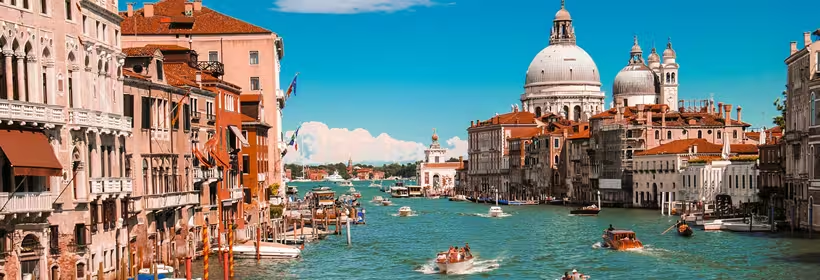
Venice's canals and gondolas have remained largely unchanged for centuries
The City
St Mark's Square and the Basilica
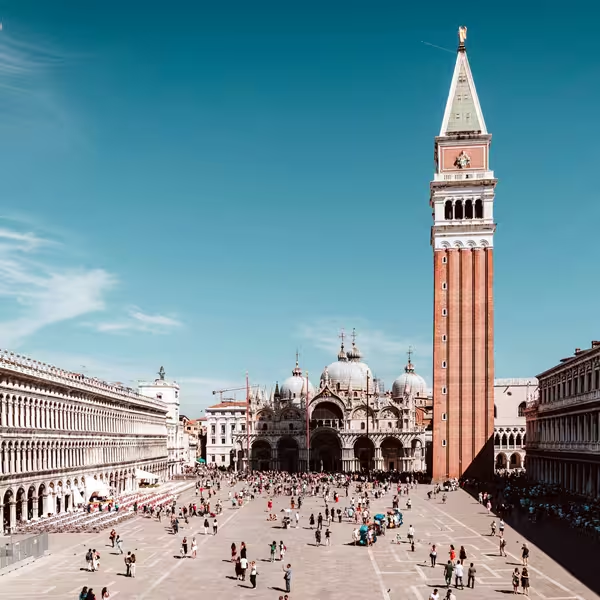
Piazza San Marco is the civic and spiritual heart of Venice, and arguably the most beautiful square in Europe. Napoleon reportedly called it the drawing room of Europe. The Basilica di San Marco, with its five Byzantine domes and its extraordinary interior of gold mosaic, stands at its eastern end and has been the ceremonial church of Venice since the 9th century. The Campanile beside it was rebuilt in 1912 after the original tower collapsed; the current version is effectively identical to its predecessor. The Doge's Palace, the formal seat of Venetian government for over a thousand years, occupies the southern side of the piazza, its pink and white Gothic facade one of the most recognisable buildings in the world.
The Grand Canal
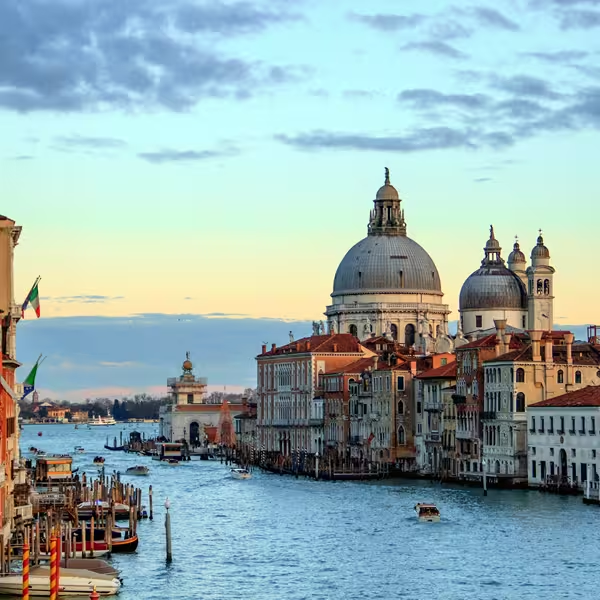
The Grand Canal is the main artery of Venice, a reverse S-shape stretching from Santa Lucia station to the lagoon near St Mark's. Its banks are lined with over 170 palaces and churches, almost all of them built between the 13th and 18th centuries by the patrician families who made Venice the wealthiest city in the world. The canal is crossed by three bridges: the Rialto, the Accademia, and the recently built Calatrava bridge near the station. The best way to see the Grand Canal in any detail is by vaporetto. The number 1 line runs the full length and stops at almost every palazzo.
The Rialto
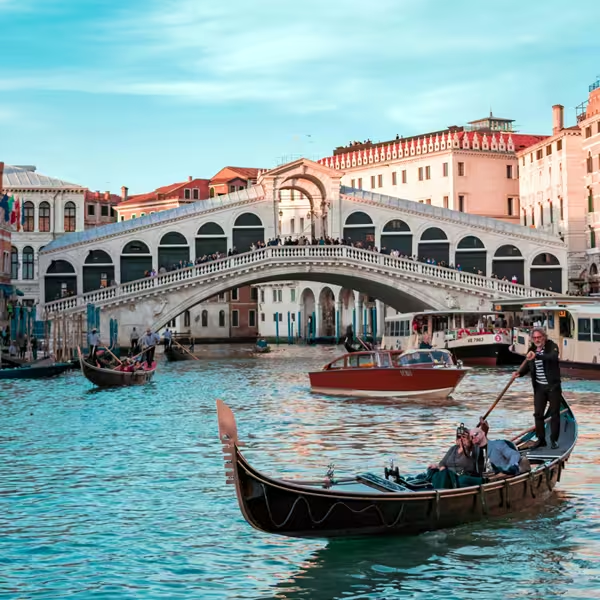
The Rialto Bridge is the oldest of the Grand Canal's three bridges, built in stone in 1591 after a series of wooden bridges at the same site had rotted or collapsed. It was the commercial centre of Venice for centuries, and the surrounding market is still active today. The fish market on the Grand Canal and the fruit and vegetable market alongside it operate every morning except Sunday and are the most vivid expression of the working city that Venice remains despite its extraordinary concentration of visitors.
Art and Culture
The Gallerie dell'Accademia contains the world's greatest collection of Venetian painting, from Byzantine altarpieces through to the great works of Bellini, Giorgione, Titian, Veronese and Tintoretto. The Peggy Guggenheim Collection in the Palazzo Venier dei Leoni on the Grand Canal houses one of the finest collections of 20th-century art in Europe, presented in a setting of remarkable beauty with a garden that runs to the water's edge. For Tintoretto specifically, the Scuola Grande di San Rocco is unmatched: an entire building decorated by one artist over more than two decades, a commission that Tintoretto won by arriving with a finished ceiling panel when the committee had asked for a sketch.
The Islands
The Venice lagoon contains dozens of smaller islands, most of them reachable by vaporetto. Murano has been the centre of the Venetian glass-blowing tradition since 1291, when the furnaces were moved there from Venice proper to reduce the fire risk to the city. Burano is famous for its brightly coloured fishermen's houses and its lace-making tradition. Torcello, the oldest inhabited island in the lagoon, contains a cathedral whose Byzantine mosaics are among the finest in existence and predate those of St Mark's Basilica by several centuries.
How to Get Around
Venice has no roads. Movement within the city is on foot or by water. The vaporetto network covers the main routes along the Grand Canal and to the outer islands. For longer distances or late-night travel, water taxis are available but expensive. Gondolas are the traditional Venice experience and while they are primarily for tourists rather than transport, an evening gondola ride through the smaller canals away from the crowds is one of the most memorable things Venice offers. The city is compact enough to walk across in under an hour, and getting lost in the calli is not so much an inconvenience as a pleasure.
When to Visit
Venice rewards visitors in every season. Spring and autumn offer the best combination of comfortable temperatures and manageable crowds. Summer is busy but the long days and warm evenings give the city a particular character. Winter, especially January, is quiet and sometimes misty: the acqua alta flooding that periodically submerges parts of the city occurs most commonly in November and December, but the MOSE flood barrier system has significantly reduced the frequency and severity of flooding since it became fully operational in 2020. Carnival in February is one of the great events in the European calendar, though Venice fills entirely at that time. The Venice Film Festival in late August and early September brings its own particular glamour.
Venice Practicalities
- Venice Santa Lucia is the main railway terminus, at the western end of the Grand Canal
- Venice Marco Polo Airport is on the mainland, approximately 13km from the city centre, linked by water taxi, Alilaguna boat service and bus
- The vaporetto (water bus) is the main public transport. Line 1 runs the entire Grand Canal and is the most useful for visitors
- Water taxis are available 24 hours and are expensive but convenient for luggage or late arrivals
- Credit cards are widely accepted; the city is generally very tourist-friendly
- Venice is not a city for large wheeled suitcases, and compact luggage is much easier to manage across the bridges and through the narrow calli
- The best times to visit the major sights are early morning or late afternoon. St Mark's Basilica in particular is transformatively different in morning light
Venice Simplon-Orient-Express Journeys to Venice
The most popular route on the Venice Simplon-Orient-Express runs between Paris and Venice. The train departs Paris Gare de l'Est in the late afternoon, crosses France and Switzerland overnight, and arrives at Venice Santa Lucia the following morning. The Alpine crossing at night, watching the mountains pass in darkness or moonlight, is one of the most memorable parts of the journey.
We can arrange complete holidays combining the train with luxury hotel accommodation in Venice and flights between Venice and the UK. We can also arrange the train booking alone if you prefer to organise your own hotels independently.
Paris to Venice
The classic overnight journey. Depart Paris in the afternoon, cross the Alps by night and arrive in Venice the following morning.
from £3,885 per person View JourneyVenice to London — 4 or 5 Nights
Fly to Venice, enjoy three or four nights in the city, then board the VSOE for the overnight journey to Paris and Eurostar home to London.
from £4,949 per person View PackageVenice Hotels
A selection of carefully chosen hotels in Venice, from classic palazzo properties on the Grand Canal to intimate boutique hotels in quieter sestieri.
View HotelsVenice to Paris
Travel from Venice to Paris on the VSOE, departing in the morning and arriving in Paris the following morning after dinner and an overnight crossing of the Alps.
from £3,885 per person View Journey