Clans, Castles and Isles 2026 / 2027
The landscapes of Scotland carry their history with them in a way that few other places in the world can match. On this five-night journey the Royal Scotsman takes you through the places where that history was made, from the silver sands of Morar to the ramparts of Stirling Castle.
The train departs Edinburgh in the afternoon and returns six days later, covering more than 700 miles of some of the finest scenery in Europe. The itinerary combines spectacular rail travel with exclusive excursions to islands, castles and Highland estates that most visitors never reach. Formal and informal dinners, whisky tastings and evening entertainment in the Observation Car ensure that the time on board is as memorable as the time spent off it.
Estimated departure from Edinburgh Waverley: 13:56. Return arrival: 09:40. All timings are indicative and subject to national railway constraints. Please check your final itinerary for confirmed timings.
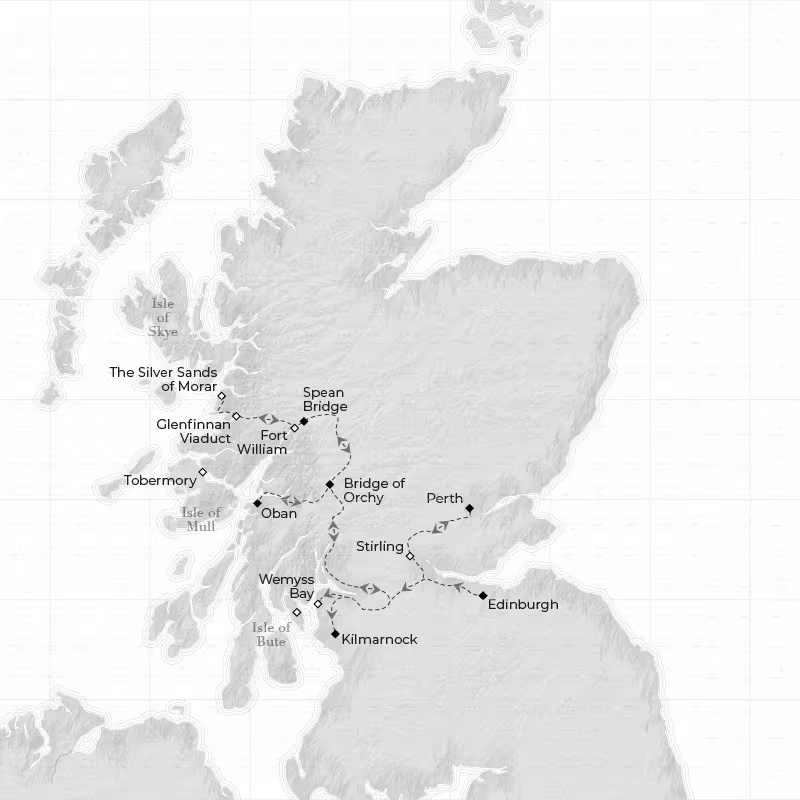
Day by Day Itinerary
Edinburgh to Spean Bridge
The Royal Scotsman departs Edinburgh in the afternoon, heading west through Falkirk, Clydebank and Dumbarton before skirting the northern edge of Glasgow and picking up the northern bank of the Clyde. This is a fine way to leave a city: the urban fabric falls away quickly and the countryside takes over with some conviction. Your cabin is waiting, the bags have been unpacked and there is no particular reason to be anywhere other than a comfortable chair with a drink in hand as the train makes its way to Spean Bridge.
Dinner this evening is informal, which on the Royal Scotsman means relaxed rather than casual. Musicians and performers join the train to provide the entertainment in the Observation Car, moving between slow Gaelic songs and livelier folk melodies in a way that feels genuinely rooted in the landscape outside. It is a good introduction to what the next five days have in store.
Spean Bridge to Oban via Arisaig and Fort William
The train heads west from Spean Bridge with Britain's highest mountain visible to the south. Ben Nevis at close range is considerably more impressive than photographs suggest, particularly in the early morning when the summit is clear. The first stop of the day is Arisaig, where a morning walk along the silver sands of Morar provides one of the more beautiful stretches of Scottish coastline. The pale white sand and the views across to the islands of Eigg and Rum on a clear day are genuinely remarkable.
The train travels back to Fort William and crosses the Glenfinnan Viaduct, a piece of engineering that looks as extraordinary in real life as it does on screen. Lunch is served as the train crosses the viaduct, which is well timed. The afternoon offers two options at Glenfinnan. The first is a guided exploration of the area with a local historian who brings the stories of the great Scottish heroes to life in the places where those stories actually happened. The second is a hike through Glen Nevis to the Steall Waterfall with mountain guides, which is one of the finer walks in the Highlands. An informal dinner follows, with Scottish music in the Observation Car into the evening.
Oban and the Hebridean Islands
Oban is the gateway to the Hebridean islands and an excellent place to spend a morning. Two excursions are available. The first is a private boat tour around the island of Kerrera, which sits just off the harbour and offers dramatic cliffs, sweeping sea views and a real sense of having stepped away from the mainland. The second is a walking tour of Oban with a historian whose particular interest is the clan history of the town and the surrounding islands. There is also the option to explore the town independently, which has its own pleasures.
Lunch is taken at a pier-front restaurant before the afternoon moves in a different direction entirely. Coinneach MacLeod, the Hebridean Baker, welcomes guests to his farmhouse for an afternoon that involves hiking the hills with friendly dogs, taking in views of the Hebridean islands, feeding Highland cows and hearing the myths and folklore of the islands from someone who knows them thoroughly. Alternatively, a visit to Easdale, a small island shaped entirely by centuries of slate quarrying, offers a landscape and atmosphere that are unlike anything else in Scotland. Whichever route the afternoon takes, it ends at the Hebridean Baker's farmhouse with whisky, award-winning shortbread and island stories. The train stables overnight at Kilmarnock.
Kilmarnock to Boat of Garten via Drumlanrig Castle
The morning takes the train south into Dumfriesshire, an area of Scotland that receives rather fewer visitors than its quality warrants. Disembarking at Sanquhar, the excursion is to Drumlanrig Castle, the turreted sandstone home of the Duke and Duchess of Buccleuch and Queensberry. The castle sits in the Nith Valley with sweeping views in every direction and contains one of the finest private art collections in Scotland, alongside important silver, porcelain and French furniture. The surrounding 90,000-acre estate takes in formal gardens, ancient woodland and miles of footpaths.
Lunch is served back on board as the train heads north again, and the afternoon is one of the pleasures of the Royal Scotsman: slow travel through the rolling hills of Perthshire as they gradually give way to the more dramatic peaks and valleys of the Highlands. The train stables overnight in the village of Boat of Garten on the private Strathspey Railway, a beautifully preserved setting deep in the Cairngorms.
Boat of Garten to Dundee via Stirling Castle
The train collects everyone at Kingussie after breakfast and heads south through Blair Atholl and Pitlochry, the Perthshire scenery at its finest in the autumn but rewarding in any season. The destination this afternoon is Stirling Castle, one of the most historically significant buildings in Scotland. The childhood home of Mary Queen of Scots and James VI, it was the seat of the Stuart monarchy for generations and the site of events that shaped the course of Scottish history.
The visit is private, beginning with a champagne and canapé reception before a guided tour of the castle that brings its remarkable story to life. The setting, on a volcanic rock above the flat Carse of Stirling with views extending to the Wallace Monument and beyond, is one of the finest in the country. The train moves to Dundee for the final overnight stop.
Dundee to Edinburgh via the Forth Railway Bridge
A final breakfast is served as the train leaves Dundee and travels south through the former Kingdom of Fife. The Forth Railway Bridge crossing is the proper ending to any Scottish rail journey: a Victorian engineering achievement that remains one of the most striking structures in Europe, looking as extraordinary now as it did when it was completed in 1890. Edinburgh Waverley is reached shortly after, bringing five nights and six days of some of the finest travel available in Britain to a close.
For onward transportation or accommodation in Edinburgh, please speak to your Train Manager who will be happy to make arrangements.
Itineraries and timings shown may be changed for seasonal or operational reasons.
Departure Dates
2026
2027
Prices Per Person
| Accommodation | Price Per Person | Notes |
|---|---|---|
| Twin or Double Cabin | from £17,250 | Based on two sharing |
| Grand Suite | from £33,900 | Based on two sharing |