The Most Famous Train Journey Never Taken
On the second night out of Istanbul the Simplon Orient Express runs into a snowdrift and stops. By morning one of the passengers is dead in a locked compartment, stabbed twelve times, and the only people who could have reached him are the twelve strangers sharing the coach. It is one of the most elegant set-ups in detective fiction, and a great deal of it was borrowed from things that had actually happened.
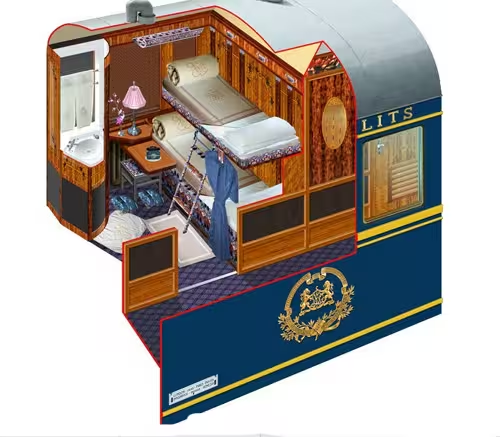
Agatha Christie wrote Murder on the Orient Express at the height of her powers, and the choice of setting was not incidental. She knew the train. She had travelled on it alone in 1928, on the first foreign journey she ever made without company, and she went on using it for years afterwards to reach the archaeological digs in Iraq and Syria where her second husband, Max Mallowan, was working. The dining car, the narrow corridor, the folding washbasin, the conductor's seat at the end of the coach — she was writing about a place she had lived in.
The story appeared first as a serial in the American Saturday Evening Post during 1933, under the title Murder in the Calais Coach. The novel followed in Britain on 1 January 1934, published by the Collins Crime Club, and in the United States on 28 February that year, where the serial title was retained. The usual explanation for the American change is Graham Greene: his Stamboul Train had been published in the States two years earlier as Orient Express, and one Orient Express on the shelves was enough.
First published
1 January 1934
US title
Murder in the Calais Coach
Setting
Simplon Orient Express, Yugoslavia
Suspects
Twelve
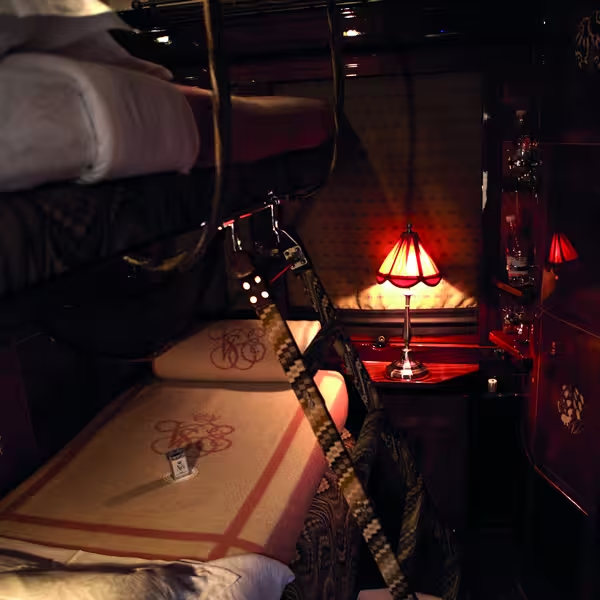
Night in a Historic Twin cabin on today's Venice Simplon-Orient-Express — the corridor, the lamp and the folding berths Christie described
The Real Events Behind the Story
The Train That Stopped in the Snow
In the winter of 1929 a blizzard closed on the Orient Express roughly fifty miles short of Istanbul, near the town of Çerkezköy in Turkish Thrace, and buried it. There were about twenty passengers on board — diplomats, businessmen and their wives, a couple of priests — and they were not going anywhere. The steam heating failed. The lighting ran down. Meals were reduced to a single ration a day and then to whatever could be bought from a nearby village, whose inhabitants were at first unwilling to sell anything at all and were eventually persuaded by money.
What lifted the incident out of the ordinary was that the passengers dug themselves out. Volunteers tunnelled through drifts that had frozen hard. The tunnel collapsed on them more than once and had to be shored up with timber and fittings stripped from the train, but they broke through in the end and crew members reached a village. Turkish soldiers arrived with sleighs and supplies, and word that a snowplough was coming. Six days after it had stopped, the train moved again. The story was reported around the world, and Christie — who was herself held up by weather on the same line in 1931 — had her snowdrift.
The Kidnapping That Shaped the Plot
The second borrowing is darker and much closer to the surface of the book. In March 1932 the twenty-month-old son of Charles Lindbergh, the most famous aviator alive, was taken from his nursery in New Jersey. A ransom was paid. The child was found dead. The case dominated the American press for years, and its damage spread well beyond the family: a maid in the household of Anne Lindbergh's mother, questioned repeatedly and never charged, took her own life while under suspicion.
Christie moved all of it wholesale into the fictional Armstrong family — a kidnapped child, a ransom paid for nothing, a mother who does not survive the shock, a father who does not survive the aftermath, and a nursemaid wrongly suspected who dies before she can be cleared. Every passenger in the Calais coach turns out to be connected to that household. The novel's real subject is not who killed the man in compartment number two. It is whether a jury of the bereaved is entitled to reach a verdict the law never delivered.
Where Christie Actually Wrote It
The Pera Palace Hotel in Istanbul keeps Room 411 as the Agatha Christie Room, complete with period furniture and a replica typewriter, and its claim that the novel was written there is repeated everywhere. It has never been documented. The Christie estate's own account points instead to Arpachiyah in northern Iraq, where she spent the 1933 season on Mallowan's dig and where the manuscript was most likely drafted. The Pera Palace is a wonderful hotel and worth a night on any Istanbul itinerary; the story about Room 411 is best enjoyed as a story.
The Real Orient Express
The train Christie put her passengers on was a genuine service, not an invention. The original Orient Express left Paris Gare de l'Est for the first time on 4 October 1883, operated by the Compagnie Internationale des Wagons-Lits, and ran east towards Constantinople. After the Simplon Tunnel opened through the Alps, a southern variant was introduced: the Simplon Orient Express, running Paris – Lausanne – Milan – Venice – Belgrade – Sofia – Istanbul. That is the train in the novel, and Vinkovci and Brod — the stations either side of Poirot's snowdrift — are real places on that line, in what was then Yugoslavia and is now Croatia.
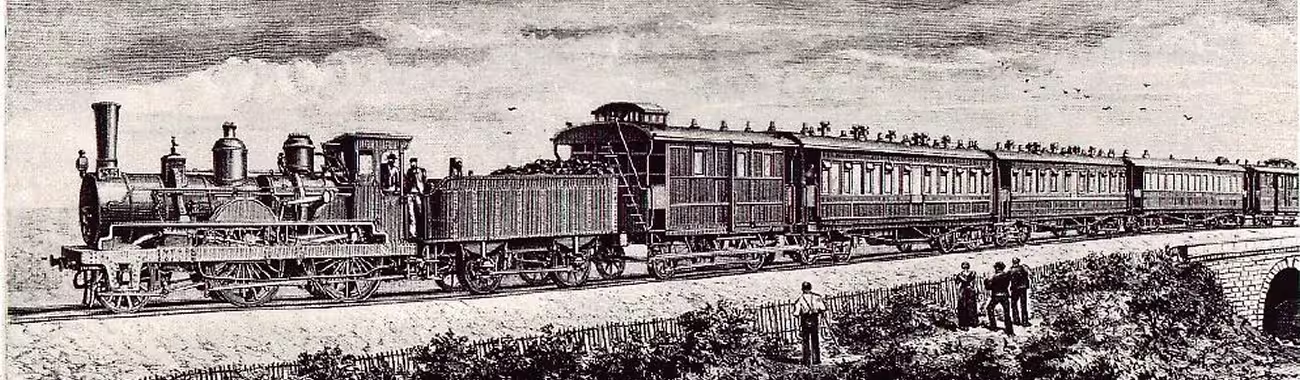
The Orient Express as it appeared in 1883, on the inaugural run from Paris Gare de l'Est
The Carriages That Survived
By the 1970s the great Wagons-Lits sleeping cars had been scattered across Europe, some in service on other railways, some standing derelict, at least one in use as a summer house. From 1977 the American entrepreneur James Sherwood began buying them back, one carriage at a time, and putting them through a restoration that took years and drew in marquetry specialists and the glassmakers at Lalique. The rebuilt train ran again in 1982 as the Venice Simplon-Orient-Express, and it is still running.
- Sleeping Car 3309 (1926, Belgium) — marooned in the 1929 snowdrift; today a Grand Suite
- Sleeping Car 3425 (1929, England) — said to have carried King Carol II out of Romania in 1940; today a Grand Suite
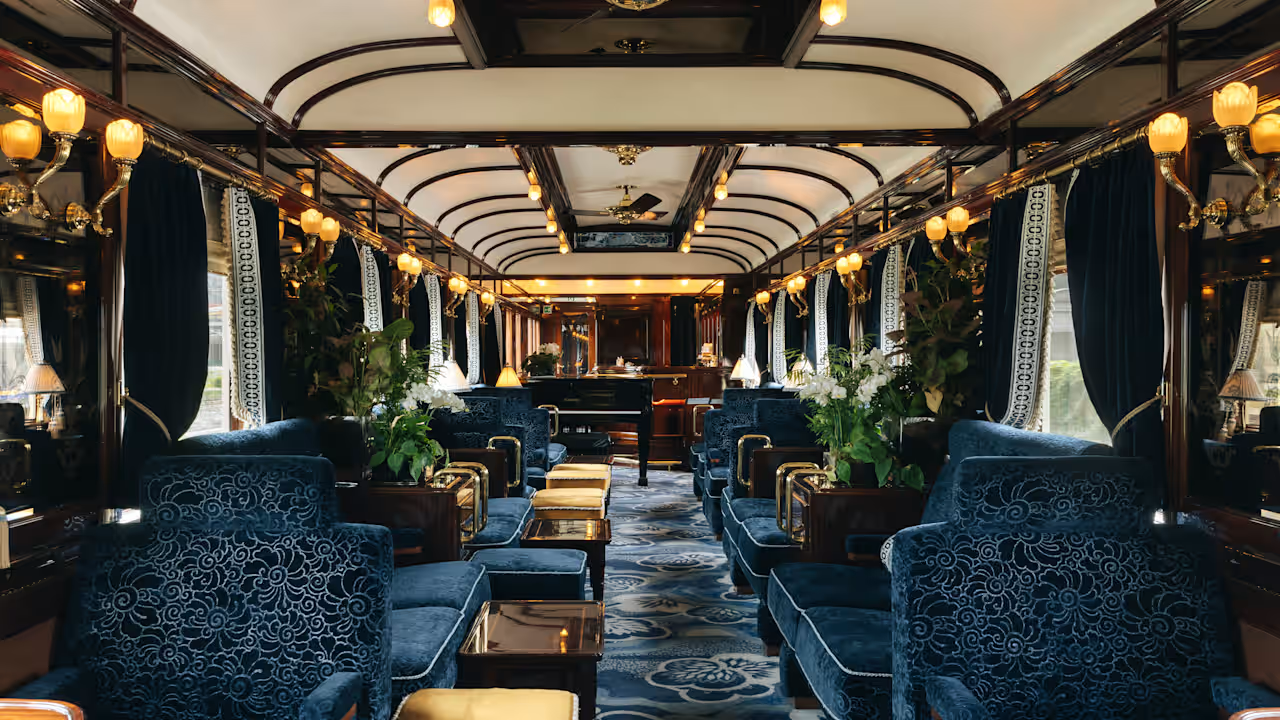
- Bar Car 3674 (1931, France) — the piano bar where the evening goes on long after dinner
- Restaurant Car 4141 (1929) — interior glass panels by René Lalique
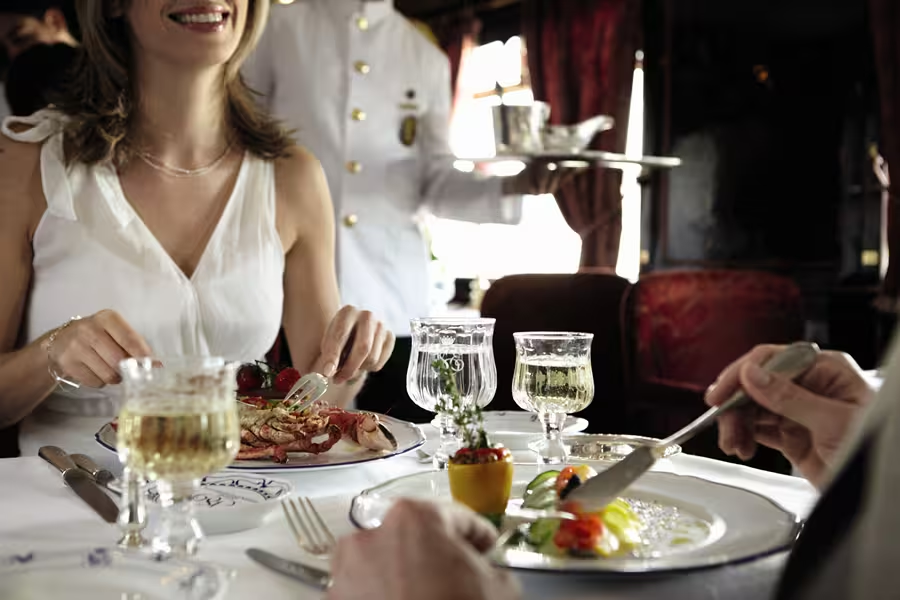
- Restaurant Cars 4095 and 4110 (1927 and 1926, Birmingham) — still serving lunch and dinner daily
On Screen
1974 — Sidney Lumet
The adaptation most people mean, and the one Christie herself was said to be happiest with. Albert Finney played Poirot inside a cast that included Sean Connery, Lauren Bacall, John Gielgud, Vanessa Redgrave, Michael York, Jacqueline Bisset and Ingrid Bergman, who won the Academy Award for Best Supporting Actress; the film took six nominations in all. Interiors were built at Elstree, and the running shots were filmed on a closed line in the French Jura between Pontarlier and Gilley. Christie attended the premiere in London. It was her last public appearance.
2010 — David Suchet
The darkest version. Made for ITV's long-running Poirot series, it strips out the glamour and plays the ending as something close to a crisis of faith for a detective who has spent a career insisting the law is not negotiable.
2017 — Kenneth Branagh
Branagh directed and starred, opposite Judi Dench, Michelle Pfeiffer, Willem Dafoe, Penélope Cruz, Daisy Ridley and Johnny Depp. The production briefly considered filming aboard a real train and gave up on it, then built two working replica rakes and a thirty-tonne locomotive at Longcross Studios outside London, along with a Stamboul station, a viaduct, and a mountainside thirty-five feet high running several hundred metres inside the building. Alpine plates shot in New Zealand were dropped in beyond the carriage windows. A stage adaptation by Ken Ludwig appeared the same year and is still touring.
Travelling the Route Today
You cannot book Poirot's exact journey — the through service from Istanbul to Calais ended long ago — but you can travel almost every part of it on the surviving carriages. The classic Paris to Venice run leaves in the late afternoon, crosses the Alps overnight and arrives the following afternoon — about twenty-five hours from platform to lagoon, and the journey most people mean when they say they want to do the Orient Express. Twice a year the train makes the full original expedition to Istanbul over five nights, leaving from Gare de l'Est exactly as the first Orient Express did in 1883. And the eastern routes to Vienna, Budapest and Prague follow much of the line the Simplon service used.
Paris to Venice
Depart Paris in the late afternoon, dine as the train runs south, cross the Alps overnight and arrive across the Venetian lagoon the following afternoon.
from £4,275 per person View JourneyParis to Istanbul
The full 1883 route, twice a year: Gare de l'Est to Istanbul over six days, with hotel nights in Budapest and Bucharest, guided excursions and the Black Sea coast.
from £18,050 per person View JourneyCabins and Suites
Historic Twin cabins, Suites with private bathrooms and the six Grand Suites — including 3309, the carriage that was buried in the snow in 1929.
View AccommodationHistory of the Orient Express
From the inaugural run of 1883 through the golden age, the wars, the decline and the rescue of the carriages that make up today's train.
Read the HistoryA Murder Mystery of Your Own
The Venice Simplon-Orient-Express does not stage murder mysteries; the continental train takes itself rather more seriously than that. Belmond runs them instead on the British Pullman, the UK day train, on circular trips out of London Victoria. The case is set in 1933 — the year Christie's story was first serialised — and it plays out around you across a five-course lunch with champagne, with the actors working the carriages between courses and the passengers expected to reach a verdict before the train gets back. It costs a small fraction of a European journey, and the Pullman cars themselves are near-contemporaries of the Wagons-Lits sleepers. For the Christie reader in the family it is close to the perfect present. Call us for current dates and fares.
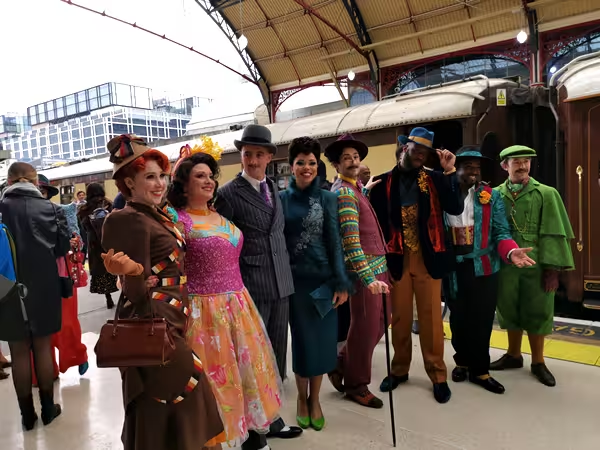
The cast assembling at London Victoria before a Murder Mystery Lunch on the Belmond British Pullman
Frequently Asked Questions
The murder is invented. The circumstances are not. The blizzard that strands the train came from a real one that buried the Orient Express near Çerkezköy in Turkey in January 1929 and held it for the best part of a week. The Armstrong family backstory came from the kidnapping and murder of Charles Lindbergh's infant son in 1932. Christie had been travelling the route herself since 1928 and knew the train intimately.
Yes. The Venice Simplon-Orient-Express runs from March to December each year using original Wagons-Lits carriages built in the 1920s and 1930s. The classic Paris to Venice journey departs at 16:00 and reaches Venice Santa Lucia at around 17:30 the following day, and starts from £4,275 per person. See our fares page for all twenty routes, or call us on 0333 405 0192.
Twice a year. The Paris to Istanbul journey takes five nights and six days, with three nights on board and two in hotels in Budapest and Bucharest, and departs from Gare de l'Est — the station the original Orient Express used in 1883. Fares start from £18,050 per person and include excursions, transfers and all meals. These departures sell out a long way ahead.
Between Vinkovci and Brod, in what was then Yugoslavia and is now Croatia. Poirot has boarded at Istanbul and is heading west towards Calais and London when the snow stops the train on the second night.
Belmond record that Sleeping Car 3309, built in Belgium in 1926, was among the coaches caught in the 1929 snowdrift. It was recovered and restored during James Sherwood's rebuilding of the train in the late 1970s and runs today as a Grand Suite. If you want to sleep in the carriage that started it all, that is the one to ask for — and to ask early.
Not on the Venice Simplon-Orient-Express. Belmond stages its murder mystery lunches and dinners on the British Pullman in the UK, on circular day trips from London Victoria, with a professional cast playing the case out between courses of a five-course lunch. See our British Pullman special events page for current dates and fares.