For centuries the Silk Road carried silk and spices, faith and invention between China and the West, its caravans threading a chain of desert oases beneath some of the most dramatic landscapes on earth. This twelve-day journey follows that ancient road in reverse, from the far west of China to the imperial capital, in the comfort of a brand-new private train.
Aboard the Golden Eagle Silk Road Express, you travel from Urumqi, deep in Xinjiang, across the deserts and mountains of western China to the great cities of the east. Along the way lie the buried cities of Turpan, the Uyghur bazaars of Kashgar, the silk workshops of Hotan and the painted Buddhist caves of Dunhuang, before the road reaches the Terracotta Army at Xi'an and, at last, the Forbidden City and the Great Wall at Beijing. It is a rare chance to see a China few travellers reach, all from a fully en-suite touring train built for exactly this kind of adventure.
Everything is arranged and included, from the excursions and entrance fees to the meals, the drinks and the gratuities. One hotel night in Urumqi and two in Beijing frame eight nights aboard the private train, with expert local guides at every stop and a tour management team and doctor travelling with you throughout.
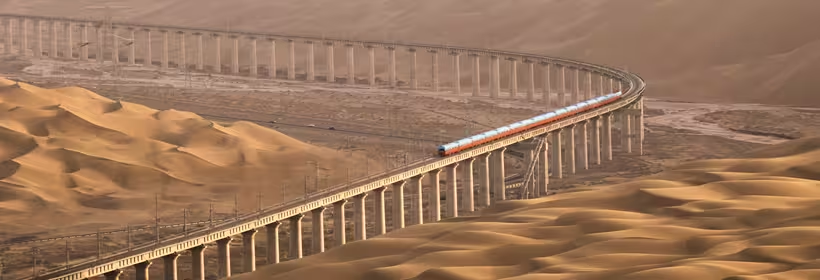
The Golden Eagle Silk Road Express crossing the desert
Journey Highlights
The Terracotta Army
Stand before the thousands of life-size warriors of Xi'an, buried for over two thousand years and often called the Eighth Wonder of the World.
The Mogao Caves
A UNESCO World Heritage Site at Dunhuang, the Cave of a Thousand Buddhas, with a millennium of Buddhist art painted into the cliffs.
The Great Wall
Walk a restored stretch of the Great Wall at Badaling, its watchtowers marching over the ridges of the mountains north of Beijing.
Kashgar & the Silk Road Cities
The Uyghur old town and Apak Khoja Tomb at Kashgar, the buried cities of Turpan and the silk workshops of Hotan, far off the usual trail.
Crescent Lake by Camel
A camel trek across the singing sands of Dunhuang to the Crescent Lake oasis, cradled improbably among the towering dunes.
Imperial Beijing
The Forbidden City, Tiananmen Square and the lakes and pavilions of the Summer Palace, the ceremonial heart of imperial China.
Day-by-Day Itinerary
Timings are indicative; confirmed details are supplied with your travel documents.
Arrival in Urumqi
Arrive in Urumqi, the capital of Xinjiang and, famously, the city furthest from any sea on earth. Transfer to the five-star Conrad Urumqi for an overnight stay, then gather this evening for a welcome reception and dinner, where you meet your Tour Manager and fellow travellers before the journey begins.
Urumqi is a fitting place to begin a Silk Road adventure. For centuries a crossroads where Chinese, Mongol, Turkic and Persian worlds met and traded, it remains a city of two cultures, its Han avenues giving way to Uyghur bazaars heaped with dried fruit, spices and mutton kebabs. Beyond the last suburbs rise the snow-capped Tian Shan, the Celestial Mountains, a reminder of just how far you have come from the sea.
Welcome reception and dinner. One hotel night at the Conrad Urumqi.
All Aboard the Silk Road Express
This morning you board the Golden Eagle Silk Road Express and settle into your cabin as the train sets out across the vast landscapes of western China. A welcoming lunch is served in the dining car, and the afternoon is yours to explore the train, watch the desert unfold from the observation car and ease into the rhythm of life on board.
First night on board. Welcoming lunch in the dining car.
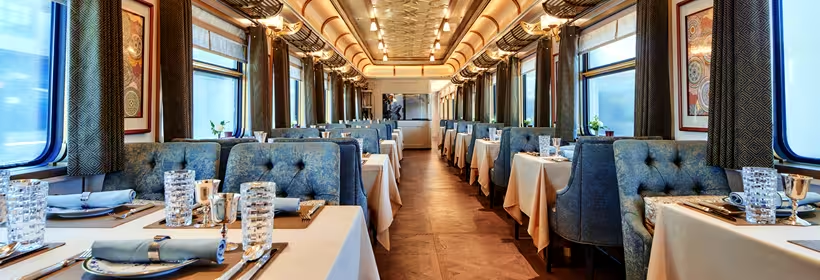
Enjoy lunch in the Golden Eagle Silk Road Express Dining Car
The Buried Cities of Turpan
Turpan sits in one of the hottest and lowest places in China, a fertile oasis ringed by desert. Here you explore the ruins of Gaochang, once a thriving Silk Road garrison town, and the extraordinary Karez system, a network of hand-dug underground channels that has carried meltwater to the fields for centuries.
You also visit the Jiaohe Ruins, one of the best-preserved ancient cities in the world, carved directly from a great earthen plateau above two converging rivers and abandoned some six hundred years ago.
Turpan sits in a deep depression, its lowest point more than a hundred and fifty metres below sea level, which makes it one of the hottest places in all of China, long known as the Land of Fire. Yet thanks to the ingenious Karez channels, meltwater from the mountains has turned it into a green sea of vineyards, and its sweet grapes and raisins are famous across the country. Nearby rise the red sandstone Flaming Mountains, immortalised in the classic Chinese tale Journey to the West, which shimmer as though ablaze in the afternoon heat.
Gaochang ancient city; Karez irrigation system; Jiaohe Ruins.
The Old Town of Kashgar
Kashgar has been a meeting point of caravans for two thousand years, the last great oasis before the mountain passes to Central Asia, and it remains the most Central Asian of Chinese cities. You visit the Apak Khoja Tomb, the holiest Muslim site in Xinjiang and the resting place of a celebrated Sufi dynasty, its dome and minarets clad in green and gold tiles.
Then you wander the narrow alleys of the old town, past the traditional Gaotai folk houses on their bluff of packed earth, with time for lunch at a local Uyghur restaurant amid the colour and clamour of the bazaar.
Kashgar is closer to Baghdad than to Beijing, and it feels it. For two thousand years it was the great junction where the northern and southern arms of the Silk Road met before the crossing of the Pamirs, and camel caravans still gave way to lorries only within living memory. Its famous market, one of the largest in Central Asia, still draws farmers and traders from across the region, and the mud-brick lanes of the old town remain one of the last places to glimpse the timeless rhythm of a Silk Road oasis.
Apak Khoja Tomb; Kashgar old town and Gaotai folk houses; Uyghur restaurant lunch.
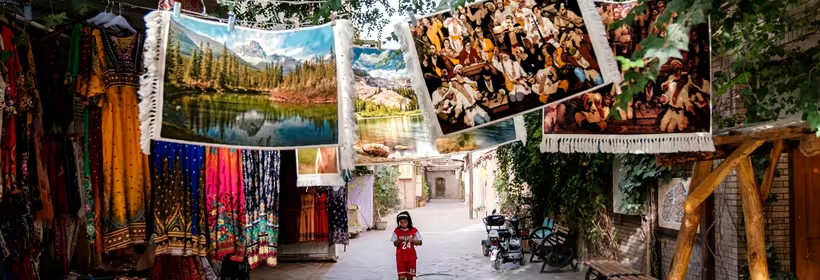
Kashgar, the last great oasis on the road to Central Asia
The Silk and Carpets of Hotan
Hotan lies on the southern arm of the Silk Road, at the edge of the Taklamakan Desert, and was long famous for its jade, silk and carpets. You visit Yotkan, the site of the ancient capital of a once-powerful Buddhist kingdom, before an exclusive visit to an Atlas silk and carpet workshop, where master weavers still work the vivid, tie-dyed patterns by hand using time-honoured techniques.
Hotan has traded in three great luxuries since antiquity: silk, carpets and, above all, jade. The white nephrite gathered from its two rivers was prized by Chinese emperors above gold, and jade-hunters still wade the shingle after the summer floods. It was here too, so the legend runs, that the secret of silk first slipped out of China, a princess said to have smuggled silkworm eggs to Hotan hidden in her elaborate headdress. Beyond the town stretches the Taklamakan, one of the largest sand deserts on earth, whose very name is a warning to travellers.
Yotkan ancient city; exclusive Atlas silk and carpet workshop visit.
The Salt Lakes of Golmud
As the train crosses onto the high Qinghai plateau, an enlightening lecture sets the history of the Silk Road in context. At Golmud there is a Freedom of Choice: journey out to the vast Chaerhan Salt Lake, a surreal expanse of salt flats and mineral formations, one of the largest of its kind in the world, or take a guided exploration of the city itself. You then re-board the train and continue east.
Golmud stands on the high, thin-aired Qinghai plateau, the roof of the world, ringed by the snows of the Kunlun mountains. It is a young frontier town in an ancient landscape, better known as the gateway to Tibet, and the Chaerhan Salt Lake to its west is a wonder in its own right: a shimmering expanse of salt and brine so vast and so solid that both a railway and a highway are built straight across its crust.
Silk Road history lecture; choice of Chaerhan Salt Lake or Golmud city tour.
The Mogao Caves and Crescent Lake
Dunhuang was the gateway where the Silk Road met the deserts of the west, and its Mogao Caves are among the wonders of the ancient world. A UNESCO World Heritage Site known as the Cave of a Thousand Buddhas, they hold a thousand years of Buddhist painting and sculpture cut into the cliff face, and you tour them to the accompaniment of traditional folk music.
In the afternoon comes one of the journey's most memorable moments: a camel trek across the great dunes of the Singing Sands to Crescent Lake, a slender ribbon of water that has survived among the desert for millennia.
Dunhuang was the throat of the Silk Road, the last watering place before the terrible deserts to the west and the point where the northern and southern routes divided. Pilgrims, merchants and monks endowed the Mogao Caves over a thousand years, filling them with murals and statues, and it was here in 1900 that a sealed library cave was discovered, its hoard of ancient manuscripts including the Diamond Sutra, the world's earliest dated printed book. Above the town, the great dunes of the Singing Sands are said to hum and roar as the wind moves them.
Mogao Caves (UNESCO World Heritage Site); camel trek to Crescent Lake.
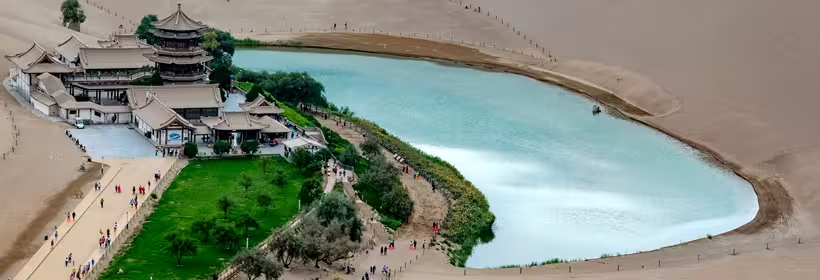
Crescent Lake, an oasis among the dunes at Dunhuang
A Day on Board and Tang Dynasty Xi'an
Today is a leisurely day aboard the train, the landscape sliding past the floor-to-ceiling windows of the observation car as you make your way towards the ancient capital. Arriving in Xi'an in the evening, you are treated to an authentic Tang Dynasty banquet, with traditional music and dance recalling the golden age when this was the greatest city on earth and the eastern terminus of the Silk Road.
Under the Tang dynasty, some thirteen centuries ago, Xi'an, then called Chang'an, may have been the largest and most cosmopolitan city in the world, home to perhaps a million people and to merchants, musicians and monks from across Asia. It was the beginning and the end of the Silk Road, the place where the caravans set out and where their silks, ideas and faiths finally arrived, and something of that swagger survives in its food, its music and the great grid of its old walls.
Day at leisure on board; Tang Dynasty dinner with music and dance in Xi'an.
The Terracotta Army
The morning is given to the old city itself: the great Ming-era walls that still encircle the centre, among the most complete in China, and the Great Mosque, one of the oldest and largest in the country, a serene blend of Chinese and Islamic design.
Then comes the moment many travellers come to China for: the Terracotta Army, the vast host of life-size warriors, horses and chariots modelled to guard the tomb of the first emperor and buried for more than two thousand years until their discovery in 1974. A farewell dinner is served on board this evening.
The army was found by chance, by farmers digging a well in the dry earth east of the city, and what they had stumbled upon was the guard set to protect Qin Shi Huang, the first emperor to unite China, in the afterlife. Thousands of warriors stand in silent ranks, each with individually modelled features, alongside horses, chariots and officials, and only a fraction of the vast tomb complex has yet been excavated. Few sights in the world so vividly conjure the ambition of the ancient world.
Xi'an city walls; Great Mosque of Xi'an; the Terracotta Army; farewell dinner on board.
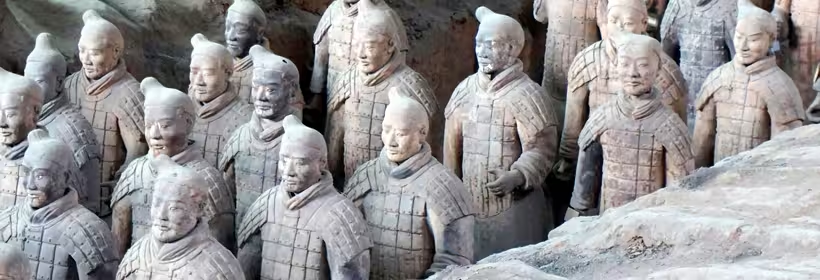
The Terracotta Army, guarding the tomb of the first emperor at Xi'an
The Forbidden City
The train reaches Beijing, journey's end for the Silk Road Express. A comprehensive tour takes in the Forbidden City, the immense palace complex from which emperors ruled for almost five centuries, the vast open sweep of Tiananmen Square, and the lakes, temples and gardens of the Summer Palace. Those who prefer can instead discover the modern face of the capital. You then transfer to the five-star Four Seasons Hotel Beijing for a two-night stay.
The Forbidden City was the seat of twenty-four emperors across the Ming and Qing dynasties, a walled city within a city of some nine thousand rooms, so sacred that for five centuries ordinary people entered on pain of death. The Summer Palace, out among lakes and wooded hills, was where the court escaped the heat of the city, its long painted galleries and marble boat the fancy of the formidable Empress Dowager Cixi. Together they are the grandest surviving expression of imperial China.
Forbidden City; Tiananmen Square; Summer Palace, or a modern Beijing tour. Two hotel nights at the Four Seasons Beijing.
The Great Wall at Badaling
This morning you travel out to the Great Wall at Badaling, the best-known and most spectacularly restored stretch of the wall, where the ramparts and watchtowers climb the ridgelines in both directions as far as the eye can see. The afternoon is at leisure, before a celebratory farewell to China with a Peking duck dinner at one of the city's most celebrated restaurants.
The Great Wall is not one wall but many, raised and rebuilt over some two thousand years to guard the empire's northern frontier, and the stretch at Badaling, the closest to Beijing, was rebuilt in stone and brick under the Ming to guard the approaches to the capital. Climbing between its watchtowers as it rides the spine of the mountains, dipping and rising as far as the eye can see, is the perfect final flourish to a journey that has followed the old roads clear across China.
Great Wall at Badaling; afternoon at leisure; Peking duck farewell dinner.
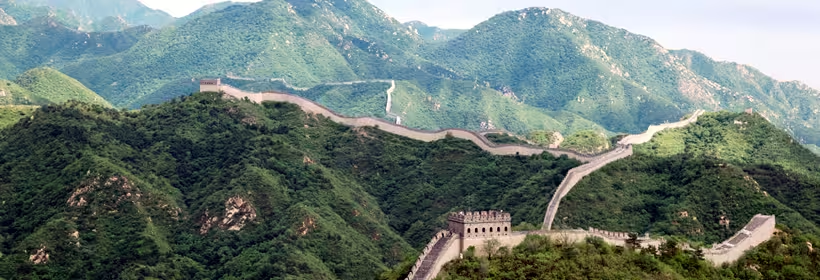
The Great Wall at Badaling, north of Beijing
Onward Journey
After breakfast, a private transfer takes you to Beijing's international airport for your onward journey home. Should you wish to see more of China, an extended stay can be arranged to round off this once-in-a-lifetime journey along the Silk Road.
Breakfast and private airport transfer. Optional extension.
What's Included
Accommodation
1 night five-star at the Conrad Urumqi, 8 nights aboard the Silk Road Express and 2 nights at the Four Seasons Beijing.
All Dining
11 breakfasts, 11 lunches and 11 dinners, freshly prepared on board and at selected venues, with inclusive drinks from the standard bar.
Excursions & Entrance Fees
Every guided excursion in the itinerary, all entrance fees, and the services of expert local guides at each stop along the way.
Service & Care
Cabin attendant with evening turndown, an experienced Tour Management team and a UK-registered doctor with medical facilities on board.
Transfers & Gratuities
Arrival and departure transfers, luggage porterage throughout, and all gratuities on and off the train.
The Silk Road Express
Eight nights aboard the brand-new private train, with its two restaurant cars, opulent bar lounge and observation car.
Fares 2027
Prices are per person and include the full programme detailed above, all excursions and entrance fees. A deposit of 25% of the tour cost secures your booking. Please call us on 0333 405 0192 for confirmed fares.
| Cabin Class | Twin (per person) from | Single (per person) from |
|---|---|---|
| Superior Cabin | £18,500 | £31,000 |
| Han Dynasty Suite | On request | On request |
Departure Dates 2027
| Departure | Return | Route |
|---|---|---|
| 29 March 2027 | 9 April 2027 | Urumqi to Beijing |
| 11 September 2027 | 22 September 2027 | Urumqi to Beijing |
Fares 2028
| Cabin Class | Twin (per person) from | Single (per person) from |
|---|---|---|
| Superior Cabin | £18,550 | £31,000 |
| Han Dynasty Suite | £65,950 | £131,900 |
Departure Dates 2028
| Departure | Return | Route |
|---|---|---|
| 27 March 2028 | 8 April 2028 | Urumqi to Beijing |
| 11 September 2028 | 23 September 2028 | Urumqi to Beijing |
The 2028 departures run for 13 days and 12 nights.
Frequently Asked Questions
Twelve days and eleven nights, travelling one way from Urumqi to Beijing along the ancient Silk Road, through Turpan, Kashgar, Hotan, Golmud, Dunhuang and Xi'an. One hotel night in Urumqi and two in Beijing frame eight nights aboard the Silk Road Express.
The Terracotta Army at Xi'an, the Mogao Caves at Dunhuang, the Great Wall at Badaling, the Uyghur old town of Kashgar, a camel trek to Crescent Lake, and the Forbidden City and Summer Palace in Beijing, among many others.
The journey is aboard the brand-new Golden Eagle Silk Road Express, a fully en-suite private touring train. You can read more on our Silk Road Express train page. There are two cabin categories, the Superior Cabin and the more spacious Han Dynasty Suite.
There are two departures in 2027: 29 March to 9 April, and 11 to 22 September. In 2028 there are two departures: 27 March to 8 April, and 11 to 23 September. Please contact us for the confirmed departures and current fares.
All accommodation, 11 breakfasts, 11 lunches and 11 dinners, inclusive drinks from the standard bar, every guided excursion and entrance fee, all transfers, gratuities and luggage porterage, plus a tour management team, local guides and a UK-registered doctor. International flights are not included.
Most visitors need a visa to enter China, and requirements vary by nationality and can change, so please check the latest guidance for your passport well in advance. Our specialists can advise on what is needed for this journey.