To travel the length of Italy is to travel through the whole sweep of European history, from the canals of Venice to the Greek temples of Sicily, and few ways of doing it can match a private train that carries you gently from one to the next. This twelve-day odyssey does exactly that, gathering up the best of the peninsula and the island at its foot.
Beginning on the Venetian lagoon and ending beneath Mount Etna in Taormina, the Golden Eagle Danube Express makes its unhurried way south, pausing at the violin workshops of Cremona, the buried streets of Pompeii, the fairytale trulli of Alberobello and the baroque of Lecce, before the great spectacle of the Straits of Messina crossing carries the whole train over the water to Sicily. There await the Valley of the Temples, the mosaics of Piazza Armerina, the opera houses and markets of Palermo, and a run of hands-on Sicilian kitchens, all rounded off in the loveliest resort on the island.
Everything is arranged and included, from the excursions and entrance fees to the cooking classes, the meals, the wines and the gratuities. Two nights in a five-star Venice hotel and two more in Taormina frame seven nights aboard the private train, with expert local guides at every stop and a tour management team and doctor travelling with you throughout.
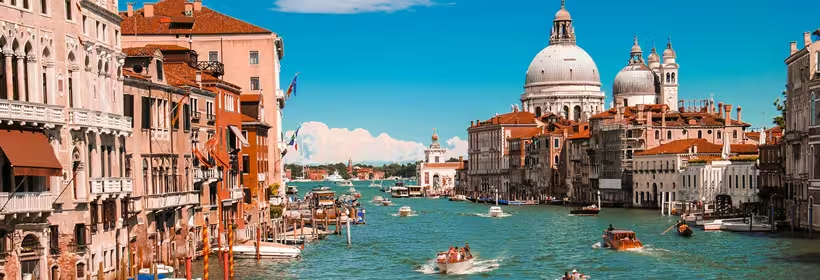
Venice on its lagoon, where the odyssey begins
Journey Highlights
Venice & a Private Concert
St Mark's Basilica and the Rialto, and a private concert in the historic church of San Zaccaria, one of the loveliest in the city.
Stradivari's Cremona
The home of the violin, where Stradivari and his rivals perfected their craft, and the museum that keeps that tradition alive.
Ferrari or San Marino
A Freedom of Choice: the Ferrari factory and museum at Maranello, or the ancient hilltop republic of San Marino.
Pompeii & Vesuvius Wine
The buried Roman city preserved by the eruption of 79 AD, followed by a tasting at a vineyard on the volcanic slopes of Vesuvius.
The Straits of Messina Crossing
The rare spectacle of the whole train taken apart and rolled aboard a ferry to cross the water to Sicily, then put back together again.
Sicily's Temples & Tables
The Valley of the Temples at Agrigento, a Sicilian cooking demonstration and a pastry class, and Mount Etna to finish.
Day-by-Day Itinerary
Timings are indicative; confirmed details are supplied with your travel documents.
Arrival in Venice
Arrive in Venice and transfer to your five-star hotel in the heart of the city. This evening, gather for a welcome dinner of fine Italian cuisine and meet your Tour Manager and fellow travellers.
There is nowhere on earth quite like Venice, a city built across more than a hundred small islands in a shallow lagoon, laced with canals and crossed by hundreds of bridges. For a thousand years it was La Serenissima, the Most Serene Republic, one of the great maritime and trading powers of the Mediterranean, and the wealth of that long golden age is written across its palaces, churches and squares.
The city was born in the fifth and sixth centuries, when people from the mainland fled the collapse of Rome and the raids that followed and took refuge among the marshes of the lagoon, driving oak piles into the mud to build on. From those unpromising beginnings grew a republic that endured for a thousand years, ruled by an elected doge, its merchant fleets, Marco Polo among them, reaching as far as China, until Napoleon finally brought the Serene Republic to an end in 1797.
Welcome dinner. Two hotel nights in Venice.
The Serene Republic
A guided walking tour takes in the highlights of the city, from the Byzantine domes and golden mosaics of St Mark's Basilica to the bustle of the Rialto market, where Venetians have shopped for their fish and vegetables for the best part of a thousand years. Those who prefer may explore at leisure, perhaps by gondola along the quiet back canals.
This evening brings a private concert in the historic church of San Zaccaria, its interior a treasury of Renaissance art, followed by dinner at the celebrated Ristorante Carpaccio.
St Mark's Basilica is the great symbol of that golden age, a building unlike any other in Italy, its five domes and glowing interior modelled on the churches of Byzantium and clad in more than eight thousand square metres of gold mosaic. Much of its splendour was carried home as plunder from the sack of Constantinople in 1204, including the four bronze horses that once stood above the doorway, and beneath the high altar lie the relics of St Mark himself, said to have been smuggled out of Alexandria in a barrel of pork to slip past the guards.
St Mark's Basilica and Rialto walking tour, or leisure; private San Zaccaria concert; dinner at Ristorante Carpaccio.
All Aboard at Cremona
A private boat carries you along the Grand Canal to Santa Lucia station, where you board the Golden Eagle Danube Express and glide out across the lagoon causeway onto the mainland. The train makes for Cremona, whose handsome medieval square is watched over by the tallest brick bell tower in Italy.
Cremona is, above all, the home of the violin. It was here that Antonio Stradivari, along with the Amati and Guarneri families, brought the craft of violin-making to a peak that has never been surpassed, and the art is still practised in workshops across the town today, recognised by UNESCO as a living human treasure. A visit to the Museo del Violino tells the story. A gourmet welcome dinner is served on board.
The modern violin was essentially invented in Cremona in the middle of the sixteenth century by Andrea Amati, and perfected a hundred years later by Antonio Stradivari, who made perhaps eleven hundred instruments across his long life. Around six hundred survive, and the finest change hands for many millions of pounds, their tone still unmatched despite centuries of study into how it was achieved. The craft never died out, and the city's workshops turn out prized handmade instruments to this day.
First night on board. Private boat transfer; Cremona and the Museo del Violino; welcome dinner on board.
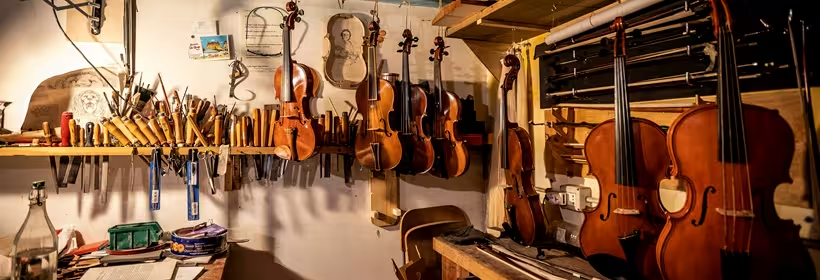
Cremona, the home of Stradivari and the art of the violin
Bologna, and Ferrari or San Marino
The morning is given to Bologna, the ancient university city known to Italians as la dotta, la grassa e la rossa, the learned, the fat and the red, for its scholarship, its cooking and its miles of terracotta arcades. A guided tour takes in the oldest university in the world, the porticoes and the leaning medieval towers, with views from the Torre di Prendiparte.
The afternoon brings a Freedom of Choice: petrolheads may head for the Ferrari factory and museum at nearby Maranello, complete with a driving simulator, while others climb to San Marino, the tiny UNESCO-listed republic on the slopes of Mount Titano, which claims to be the oldest surviving sovereign state in the world. A refined dinner is served aboard the train.
Bologna's university, founded in 1088, is the oldest in the world, and helped earn the city its nickname of the learned; the fat comes from a kitchen that gave us tortellini, tagliatelle and the true ragù, and the red from both its terracotta roofs and its politics. Its most singular feature is some forty kilometres of covered arcades, or porticoes, now protected by UNESCO, under which you can cross almost the whole city sheltered from sun and rain. San Marino, for its part, is a genuine curiosity: a mountaintop micro-state that traces its founding to a Christian stonemason in the year 301 and has clung to its independence ever since.
Bologna guided tour; choice of Ferrari at Maranello or San Marino; dinner on board.
Pompeii and the Slopes of Vesuvius
Today you tour Pompeii, the Roman city frozen in time by the catastrophic eruption of Mount Vesuvius in 79 AD, its streets, houses, shops and frescoes preserved for nearly two thousand years beneath the ash. To walk them is to step directly into the daily life of the ancient world in a way that no other place allows.
In the afternoon you visit the Casa Setaro vineyard on the volcanic slopes of Vesuvius itself, where the rich mineral soil gives the wines their character, for a tasting paired with local specialities. The famous Lacryma Christi, the Tears of Christ, has been grown on these slopes since antiquity.
When Vesuvius erupted in the late summer of 79 AD it buried Pompeii and neighbouring Herculaneum under metres of ash and pumice within hours, a disaster described in a famous eyewitness account by the young Pliny, whose uncle died leading a rescue by sea. The ash sealed the city so completely that its bakeries, taverns, baths and painted villas survived almost intact, and the hollows left in the ash by the dead, filled with plaster by archaeologists, have preserved their very poses. Even now, after more than two centuries of excavation, roughly a third of Pompeii still lies buried.
Behind-the-scenes Pompeii tour; Casa Setaro vineyard tasting on Vesuvius.
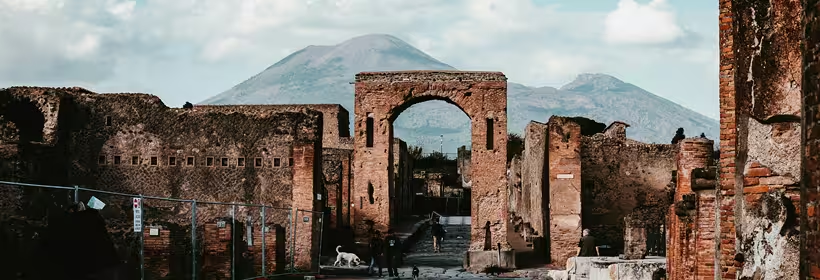
Pompeii, frozen in time beneath Vesuvius
The Trulli of Alberobello and Baroque Lecce
The morning is spent in Alberobello, a UNESCO World Heritage Site and one of the strangest and most charming towns in Italy, its streets lined with trulli, whitewashed round houses with conical stone roofs built without mortar in a technique that goes back centuries. There is a tasting of local wine or olive oil among them.
In the afternoon comes Lecce, so rich in the honey-coloured baroque carved from its soft local limestone that it is often called the Florence of the South, with its ornate Duomo and the extravagant facade of the Basilica di Santa Croce. The train travels on through the green hills of the Cilento National Park towards the toe of Italy.
The trulli owe their curious form to a canny piece of tax avoidance: built dry, without mortar, they could be swiftly pulled down whenever the tax inspectors of the Kingdom of Naples came to count the houses, then raised again once they had gone. Many of their conical roofs are still painted with mysterious symbols, religious, pagan or protective, and Alberobello alone has well over a thousand of them. Lecce, down in the heel of Italy, owes its extravagant baroque to a happy accident of geology: the local stone is soft and golden and easily carved when freshly quarried, hardening in the air, which tempted generations of masons into ever more elaborate flights of fancy.
Alberobello and its trulli, with wine or olive oil tasting; Lecce and its baroque churches.
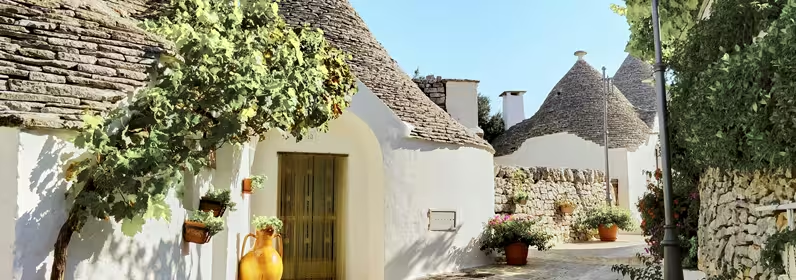
The trulli of Alberobello, unique in all the world
Across the Straits to Palermo
The night brings one of the great moments of European rail travel. To reach Sicily, the train is gently taken apart and rolled aboard a waiting ferry to cross the Straits of Messina, before being reassembled on the far shore. You may stay in your cabin for the crossing or go up onto the ferry's top deck to watch, waking to breakfast as the train rolls on into Sicily.
In Palermo, a walking tour explores the markets, palaces and Arab-Norman architecture of the old town, followed by an aperitif and a private concert at the Teatro Massimo, the largest opera house in Italy. In the afternoon there is a choice between the thought-provoking Anti-Mafia exhibition at Corleone and the dazzling golden mosaics of Monreale Cathedral.
Palermo was founded by Phoenician traders some two and a half thousand years ago and has since been ruled in turn by Greeks, Romans, Arabs and Normans, each leaving their mark. Its greatest flowering came under the Norman kings of the twelfth century, who fused Arab, Byzantine and Latin art into something wholly original, seen at its most dazzling in the gold-ground mosaics of the royal chapels and of Monreale. That same layering runs through the city's celebrated street food, from arancini and panelle to the great sheet-pizza sfincione, best sampled in the shouting, jostling markets of the old town.
Straits of Messina crossing; Palermo old town; Teatro Massimo concert; choice of Corleone or Monreale.
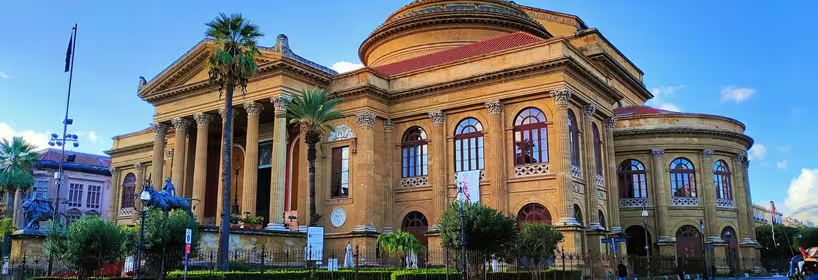
The Teatro Massimo opera house in Palermo, Sicily
The Valley of the Temples and a Sicilian Kitchen
The morning belongs to the Valley of the Temples at Agrigento, a UNESCO World Heritage Site and one of the greatest concentrations of Greek architecture anywhere, its honey-gold Doric temples standing along a ridge above the sea, better preserved than almost anything in Greece itself. In their day they were the pride of Akragas, one of the leading cities of the Greek world.
In the afternoon the train reaches hilltop Ragusa, rebuilt in golden baroque after the earthquake of 1693, where a hands-on cooking demonstration reveals the techniques and secrets of authentic Sicilian cuisine.
Founded around 580 BC, ancient Akragas grew so rich and splendid that the poet Pindar called it the most beautiful city of mortals. Its ridge of temples was raised in the fifth century BC, and the Temple of Concordia survives almost complete, largely because it was turned into a Christian church in the sixth century and so was never quarried for its stone. Each February the ancient columns stand in a haze of pink and white when the surrounding almond trees come into blossom.
Valley of the Temples, Agrigento; Ragusa; Sicilian cooking demonstration.
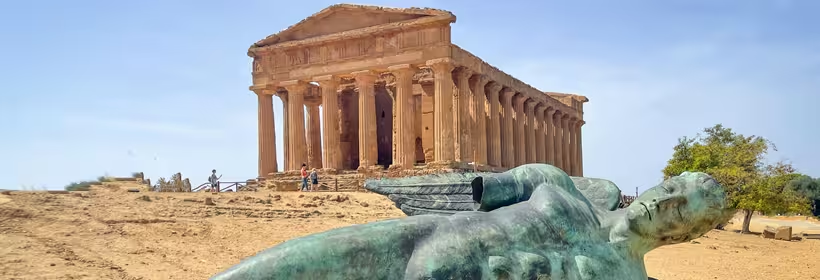
The Valley of the Temples at Agrigento
Syracuse, Ceramics and Roman Mosaics
The day begins with a gentle boat tour around Ortigia, the little island that forms the ancient heart of Syracuse. Once the most powerful city in the Greek world, a rival to Athens itself and the home of Archimedes, Syracuse today is a honey-coloured maze of temples, palaces and sunlit squares. Lunch is served on board.
The journey continues to Caltagirone, famous since the tenth century for its ceramics, for a visit to an artisan's workshop, and to the Villa Romana del Casale near Piazza Armerina, whose Roman floor mosaics, among the finest and most extensive in the world, lay protected beneath a mudslide for centuries.
In its prime Syracuse was one of the largest and most powerful cities in the whole Greek world, birthplace of the great mathematician Archimedes and famous for destroying an invading Athenian fleet in 413 BC. Its cathedral is built directly around the columns of an ancient Greek temple to Athena, which still stand within its walls. Caltagirone, up in the hills, has made majolica pottery for a thousand years and shows it off on a monumental staircase of one hundred and forty-two steps, each tread faced with a different hand-painted design.
Ortigia boat tour, Syracuse; lunch on board; Caltagirone ceramics workshop; Villa Romana del Casale mosaics.
Catania and a Pastry Class
The morning is free to explore Catania, the island's lively second city, sitting boldly at the very foot of Mount Etna and largely built from the black lava stone of its eruptions, rebuilt in handsome baroque after the earthquake of 1693. Here you take a hands-on Sicilian pastry class, learning the art behind the island's beloved sweets, from crisp shells of cannoli to the almond and ricotta of cassata.
In the afternoon the train makes the short, scenic run up the coast to Taormina, where you leave it behind for a two-night hotel stay.
Catania has lived in the shadow of Etna throughout its existence, overrun by lava in 1669 and flattened by the great earthquake of 1693, then rebuilt in a striking baroque that sets pale stone against the black volcanic rock the mountain provides in such abundance. Its emblem, perched on a fountain in the main square, is a little Roman elephant carved from lava, and the city was the birthplace of the composer Vincenzo Bellini, whose name it has since attached to half of everything, including its best-known pasta dish.
Catania at leisure; Sicilian pastry class; train to Taormina. Two hotel nights in Taormina.
Mount Etna and Taormina
This morning brings a private visit to the Mount Etna museum, led by a local volcanologist, followed by lunch and a wine tasting at a traditional palmento, a working wine estate on the volcano's fertile slopes, where the mineral-rich soil produces some of Sicily's most characterful wines.
The afternoon is free to explore Taormina, the loveliest of the island's resorts, perched high above the sea. Its great treasure is the ancient Greek theatre, from whose tiers the view frames both the coast and the smoking summit of Etna. This evening, a farewell dinner with champagne celebrates the end of the odyssey.
Mount Etna is the highest and most active volcano in Europe, rising to some three thousand three hundred metres and almost always trailing a plume of smoke, its lower slopes worked for vineyards, olives and citrus on soil made rich by the ash. Taormina has drawn travellers since the days of the Grand Tour, and its Greek theatre, cut into the hillside in the third century BC and later enlarged by the Romans, remains perhaps the most beautifully sited in the world, its broken columns framing the sweep of the coast and the volcano beyond.
Mount Etna museum with a volcanologist; palmento lunch and wine tasting; Taormina and its Greek Theatre; farewell dinner with champagne.
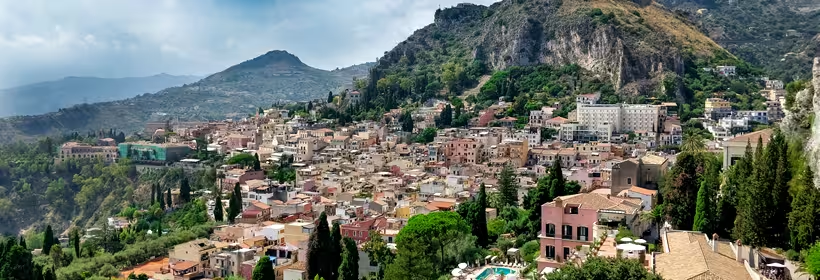
Taormina, above the sea beneath Mount Etna, where the journey ends
Onward Journey
After breakfast, a private transfer takes you to the airport for your onward journey home. Should you wish to linger a little longer in Sicily, an extended stay can be arranged to round off this grand journey through Italy.
Breakfast and private airport transfer. Optional extension.
What's Included
Accommodation
2 nights five-star in Venice, 7 nights aboard the Danube Express and 2 nights five-star in Taormina.
All Dining
Breakfasts, lunches and dinners throughout, freshly prepared on board and at selected venues, with inclusive alcoholic and non-alcoholic beverages.
Culinary Experiences
The Sicilian cooking demonstration at Ragusa, the pastry class in Catania, and vineyard tastings on the slopes of Vesuvius and Etna.
Excursions & Concerts
Every guided excursion and entrance fee, the Freedom of Choice options, and the private concerts at San Zaccaria and the Teatro Massimo.
Service & Care
Cabin attendant with evening turndown, an experienced Tour Management team and a UK-registered doctor with medical facilities on board.
Transfers & Gratuities
Arrival and departure transfers, luggage porterage throughout, and all gratuities on and off the train.
Fares 2027
Prices are per person and include the full programme detailed above, all excursions, entrance fees and the culinary experiences. A deposit of 25% of the tour cost secures your booking. Please call us on 0333 405 0192 for confirmed fares.
| Cabin Class | Twin (per person) from | Single (per person) from |
|---|---|---|
| Deluxe Class | £23,200 | £39,100 |
| Superior Deluxe Class | £29,100 | £48,700 |
Departure Dates 2027
| Departure | Return | Route |
|---|---|---|
| 29 August 2027 | 9 September 2027 | Venice to Taormina |
Fares 2028
| Cabin Class | Twin (per person) from | Single (per person) from |
|---|---|---|
| Deluxe Class | £25,250 | £42,400 |
| Superior Deluxe Class | £31,550 | £52,900 |
Departure Dates 2028
| Departure | Return | Route |
|---|---|---|
| 9 September 2028 | 20 September 2028 | Venice to Taormina |
Frequently Asked Questions
Twelve days and eleven nights, travelling one way from Venice to Taormina down the length of Italy, through Cremona, Bologna, Pompeii, Alberobello and Lecce, then across to Sicily for Palermo, Agrigento, Ragusa, Syracuse, Catania and Taormina. Two hotel nights in Venice and two in Taormina frame seven nights aboard the Danube Express.
A private concert in Venice, Stradivari's Cremona, a choice of Ferrari or San Marino, Pompeii and a Vesuvius vineyard, the trulli of Alberobello, a Teatro Massimo concert, the Valley of the Temples, a cooking demonstration and a pastry class, and Mount Etna.
To reach Sicily, the train is gently taken apart and rolled aboard a ferry to cross the Straits of Messina overnight, then reassembled on the far side. It is a rare and remarkable experience, and one of the most memorable moments of the journey.
The journey is aboard the Golden Eagle Danube Express, a boutique private train with en-suite Deluxe and Superior Deluxe cabins. You can read more on our Danube Express train page.
The 2027 departure runs from 29 August to 9 September and the 2028 departure from 9 to 20 September. Please contact us for the confirmed departures and current fares.
All accommodation, meals on board and at selected venues with inclusive drinks, every guided excursion and entrance fee, the cooking and pastry classes, the vineyard tastings and the concerts, all transfers, gratuities and luggage porterage, plus a tour management team and a UK-registered doctor. International flights are not included.