For more than a thousand years, silk, spice, ideas and faith moved along the Silk Road between China and the West. This is your invitation to follow that same path in extraordinary comfort.
The Grand Silk Road from Tashkent to Beijing is one of the most complete rail adventures on earth. Over twenty two unhurried days you cross five countries, trace the caravan routes that shaped human history and sleep each night in the quiet luxury of your own private train. You begin among the sapphire tiled mosques of Uzbekistan, wind through the mountains and lakes of Kyrgyzstan and Kazakhstan, then push deep into western China before arriving at the gates of Beijing.
This is not a race between famous sights. It is a journey built for people who want to understand a place, to walk its old towns with expert guides, to share a table with fellow travellers and to watch the landscape change slowly from a picture window. Two Golden Eagle trains carry you across the region, supported by carefully chosen five star hotels in the great cities at either end. Everything is arranged so that you can simply arrive, settle in and let the ancient world unfold.
Journey Highlights
A single trip that gathers many of the wonders of Central Asia and China into one seamless itinerary.
Samarkand and the Registan
Stand before the three towering madrassas of Registan Square and watch them glow during a private evening light show.
The Terracotta Army
Come face to face with the thousands of life sized warriors standing guard over the tomb of China's first emperor at Xian.
Walled City of Khiva
Step inside a living museum of minarets, madrassas and bazaars that has stood for around two and a half thousand years.
Eagle Hunters of Issyk Kul
Meet Kyrgyz horsemen who keep the ancient tradition of hunting with golden eagles alive beside a vast mountain lake.
Mogao Caves at Dunhuang
Explore the Cave of a Thousand Buddhas, a cliff face carved with Buddhist art across more than a thousand years.
The Great Wall of China
Walk a restored stretch of the Great Wall at Badaling, a fitting finale to a journey across a continent.
Why Travel the Silk Road by Private Train
The beauty of a private train is that your hotel travels with you. You unpack once, then wake in a new place almost every morning without the endless cycle of airports, transfers and packing. While you dine or sleep, the train carries you onward across deserts, steppe and mountain passes that few visitors ever see.
The distances here are vast and the roads are often difficult, so rail is by far the most graceful way to link these far flung cities. Each day follows a gentle rhythm. Mornings and afternoons are given to guided touring, with local specialists who bring the history to life. Evenings return you to the warm welcome of the train, where a pianist plays in the bar car, dinner is served by candlelight and the conversation flows between people who share your love of travel.
Golden Eagle has spent decades perfecting this style of expedition. The result is a journey that feels effortless from the moment you arrive to the moment you say farewell in Beijing.
The Lands You Will Discover
Uzbekistan, heart of the Silk Road
Your journey begins in the country that holds more Silk Road treasure than any other. Tashkent opens the door with its museums and its ancient Koran. From there you reach the fabled trio of Bukhara, Khiva and Samarkand, cities whose mosques, minarets and trading domes have drawn travellers for centuries. You also visit lesser known gems such as Kokand and Margilan, where silk is still woven by hand using methods passed down through generations.
Tajikistan and the mountain republics
A visit to Dushanbe reveals the proud culture of Tajikistan, framed by some of the highest mountains in the world. Further along the route, Kyrgyzstan offers the wide waters of Lake Issyk Kul and a warm welcome from nomadic communities whose traditions have barely changed in centuries.
Kazakhstan and the gateway to China
Almaty, the elegant former capital of Kazakhstan, sits beneath snow capped peaks and marks the point where the journey turns east. A private flight then carries you across the border to Kashgar, the great oasis market town of western China and one of the most atmospheric places on the entire Silk Road.
Western China to Beijing
The final chapters take you through Hotan, Golmud and Dunhuang, past salt lakes, desert oases and cliffs full of Buddhist art. You reach Xian and its Terracotta Army before the train delivers you to Beijing, where the Forbidden City, the Summer Palace and the Great Wall bring your Silk Road story to a magnificent close.
Day by Day Itinerary
Twenty two days from Tashkent to Beijing. Every excursion below is guided and included, with fine dining and comfortable accommodation throughout. The pace is generous, so there is always time to look, to linger and to understand each place rather than simply tick it off.
Welcome to Uzbekistan
Your adventure begins in Tashkent, the capital of Uzbekistan and the largest city in Central Asia. On arrival you are met and transferred to your five star hotel, with time to rest and settle in before the evening.
Tashkent has been a Silk Road crossroads for more than two thousand years, though much of the modern city was rebuilt after a great earthquake in 1966. The result is an intriguing mix of wide tree lined boulevards, leafy squares and pockets of the old town where traditional mahalla neighbourhoods still cluster around their mosques and bazaars. This evening you gather with fellow travellers for a champagne reception and a welcome dinner, the first taste of the hospitality that will define the journey ahead.
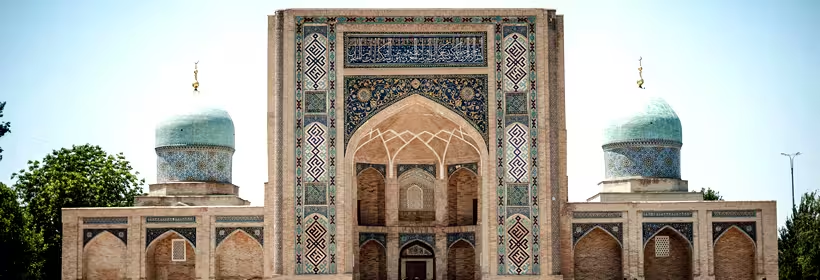
Tashkent, capital of Uzbekistan and the largest city in Central Asia
Old Town Treasures and the Golden Eagle
This morning you explore the historic quarter of Tashkent. A highlight is the Hazrati Imam complex, home to one of the oldest Qurans in the world, a magnificent manuscript traditionally linked to the Caliph Uthman and dated by scholars to the eighth or ninth century. Its weathered pages are a moving reminder of how far and how long faith and learning have travelled along this road.
You also visit the Railway Museum, with its collection of historic locomotives, and the Museum of Applied Arts, housed in a beautifully decorated former diplomat's residence that is a work of art in its own right. In the afternoon comes a moment many guests look forward to for years. You step aboard the Golden Eagle, your private train and home for the next stretch of the journey, and celebrate your first night on the rails with dinner in the elegant restaurant car as Uzbekistan slips by outside.
Palaces, Ceramics and Silk
Today the train carries you into the fertile Fergana Valley, one of the most productive and culturally rich corners of Central Asia. In Kokand you tour the Palace of Khudayar Khan, a lavish nineteenth century royal residence with a richly tiled facade, and the serene Jami Mosque with its slender minaret and forest of carved wooden columns.
The valley is famous for its craftsmen. In the small town of Rishtan a master potter shows you how the region's celebrated turquoise and blue ceramics are made, using glazes prepared from local minerals to age old recipes. Then in Margilan, the silk capital of Uzbekistan, you watch the whole journey from cocoon to cloth. Skilled weavers still spin and dye silk by hand and create the shimmering ikat patterns, known here as atlas and adras, using techniques handed down within families for generations.
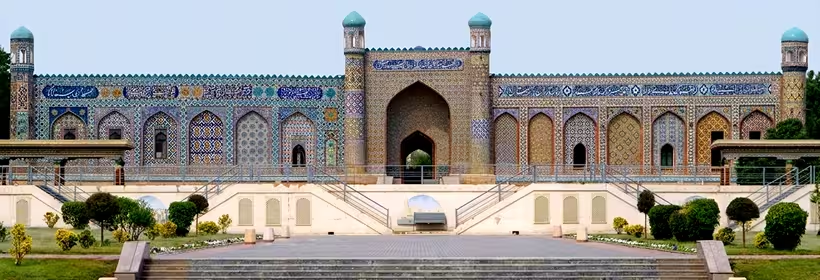
The Palace of Khudáyár Khán in Kokand
A Holy City of the Desert
Bukhara is one of the best preserved medieval cities in the Islamic world and its historic centre has been a UNESCO World Heritage Site since 1993. Once home to hundreds of mosques and religious schools, it was long revered as one of the holiest cities in Central Asia, and its old lanes still hum with the atmosphere of a great caravan town.
You explore the mighty Ark fortress, the royal citadel that dominated the city for more than a thousand years, then stand beneath the towering Kalyan Minaret. Built in 1127, it was so beautiful that it is said to have been spared even by Genghis Khan. Around it rise the Kalyan Mosque and the Mir i Arab madrassa on the grand Poi Kalyan square. You wander the ancient trading domes where merchants still sell carpets, spices and metalwork, pause at the tranquil pool of Lyabi Hauz and visit the summer palace of the last emir, the Palace of the Moon and Stars. Weather permitting, the day ends with a barbecue served right on the platform beside your waiting train.
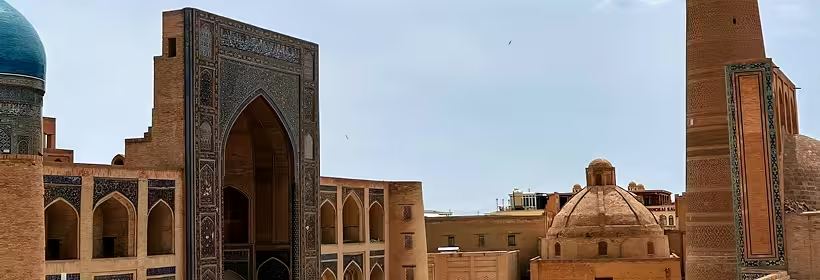
The Poi Kalyan complex in Bukhara, crowned by its twelfth century minaret
The Savitsky Museum
In the remote city of Nukus, capital of the Karakalpakstan region out towards the vanished Aral Sea, you discover one of the most surprising art collections on earth. The Igor Savitsky Museum holds around ten thousand works of Russian and Central Asian avant garde art, widely regarded as the second largest collection of its kind in the world after the Russian Museum in Saint Petersburg.
Its story is remarkable. During the Soviet years, when this modernist art was banned and its creators persecuted, the collector Igor Savitsky quietly gathered and hid thousands of canvases far from the eyes of the authorities in this distant desert outpost. To stand among them today, so far from anywhere, is one of the unexpected joys of the whole journey.
Inside the Ancient Walls
Khiva may be the most complete Silk Road city of them all. Its walled inner town, Itchan Kala, was the first place in Uzbekistan to be inscribed by UNESCO, back in 1990, and the history of the oasis reaches back roughly two and a half thousand years. Once the last stop for caravans before the long desert crossing to Persia, it later gained a darker fame as a slave market on the edge of the known world.
Within its mud brick walls you find a spellbinding maze of mosques, madrassas, minarets, palaces and bazaars, most of them little changed in centuries. You see the stout turquoise stump of the Kalta Minor minaret, intended to be the tallest in the region, the fortified Kunya Ark of the khans and the elegant carved columns of the Juma Mosque. Walking here as the low sun turns the brickwork to gold feels like stepping straight into an old tale of the East.
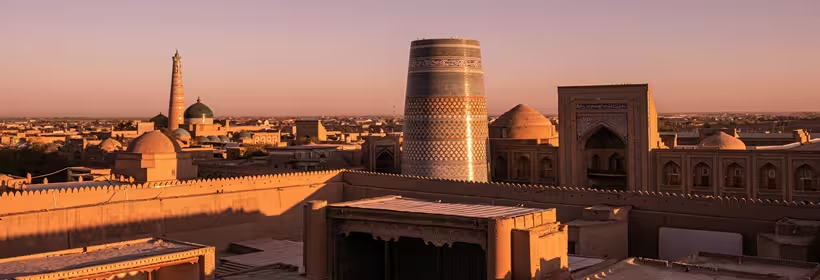
Itchan Kala, the walled heart of Khiva and Uzbekistan's first UNESCO site
Capital Beneath the Mountains
Cross into Tajikistan for a day in its capital, Dushanbe, a green and spacious city ringed by some of the highest mountains on the planet. Your expert guides lead you through the excellent Museum of National Antiquities, whose treasures include a serene reclining Buddha recovered from an ancient monastery, and the ornate Kohi Navruz, a vast and richly decorated ceremonial palace.
You also see the striking Ismail Samani monument, raised in honour of the founder of the Samanid dynasty who is celebrated as a father of the Tajik nation, and stroll through Independence Square before browsing the colourful stalls of the Mehrgon bazaar. It is a warm and genuine introduction to a proud country that few travellers ever reach.
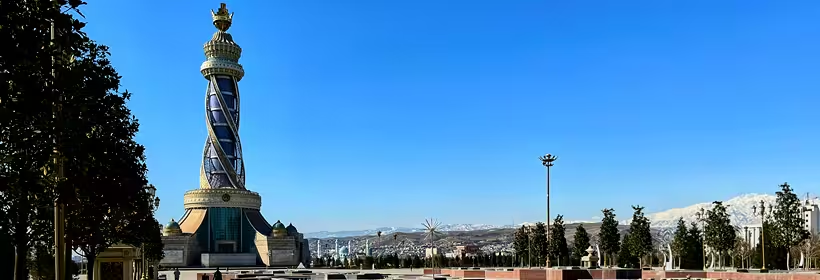
Dushanbe, capital of Tajikistan, framed by the peaks of the Pamir foothills
Birthplace of Tamerlane
Shahrisabz was the home town of Amir Timur, the fearsome conqueror known in the West as Tamerlane, who was born nearby in 1336 and went on to build one of history's great empires. The town's historic centre is a UNESCO World Heritage Site, and its monuments speak of Timur's boundless ambition.
Chief among them are the colossal remains of the Ak Saray palace, his summer residence, begun in 1380 and intended to outshine anything else in his realm. Though only the vast gateway survives, its scale still takes the breath away, and fragments of its intricate blue mosaic and flowing Quranic inscriptions hint at the splendour of the whole. Nearby stands a proud statue of Timur, gazing out over the town where his extraordinary story began.
The Jewel of the Silk Road
Few names in all of travel carry the romance of Samarkand, a city more than two and a half thousand years old that sat at the very centre of the Silk Road world. At its heart lies the Registan, surely one of the most magnificent public squares ever built, framed by three great madrassas. The Ulugh Beg madrassa was raised between 1417 and 1420, while the facing Sher Dor and the golden Tilya Kori followed around two centuries later, in the sixteen hundreds. Together their tiled portals and ribbed domes form an unforgettable sight.
You also visit the immense Bibi Khanym Mosque, built between 1399 and 1404 on the order of Timur and named for his senior wife, and climb to the remains of the Ulugh Beg Observatory. Here in the 1420s Ulugh Beg, a grandson of Timur who was as gifted an astronomer as he was a ruler, charted the stars with astonishing accuracy long before the telescope. As darkness falls you take your seat for a private illuminated show, watching the Registan glow against the night sky.
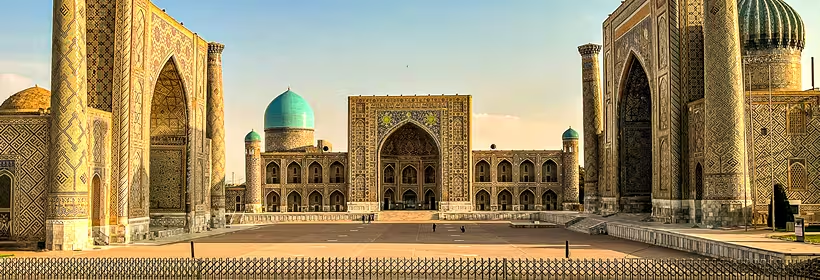
Registan Square, the majestic heart of Samarkand
Necropolis and Frescoes
A second full day in Samarkand lets you slow the pace and go deeper into its layers of history. You walk the beautiful Shah i Zinda, an avenue of mausoleums climbing a gentle hillside, their walls sheathed in some of the finest tilework in the Islamic world. The ensemble grew over centuries, with most of its shrines dating from the eleventh to the fifteenth century, and it remains a revered place of pilgrimage.
You then visit the Afrasiab Museum, built on the site of the original ancient city. Its prize is a set of vivid wall paintings from the seventh century, the Ambassadors' Frescoes from the palace of the Sogdian ruler Varkhuman, which show envoys and caravans arriving from across Asia. They are a rare and precious window onto the cosmopolitan Silk Road world at its height.
Into the Kyrgyz Capital
The train rolls on into Kyrgyzstan, a small and mountainous republic where the peaks of the Tien Shan rise almost straight from the city streets. In the capital, Bishkek, you explore the grand Ala Too Square, laid out in 1984, where a ceremonial guard keeps watch over the national flag and monuments recall the country's long road to independence.
You stroll through the leafy Soviet era parks that give Bishkek its relaxed and green character, a pleasant contrast to the deserts and ancient cities of the days before. It is the gateway to one of the most memorable experiences of the entire trip, which awaits you tomorrow beside a great mountain lake.
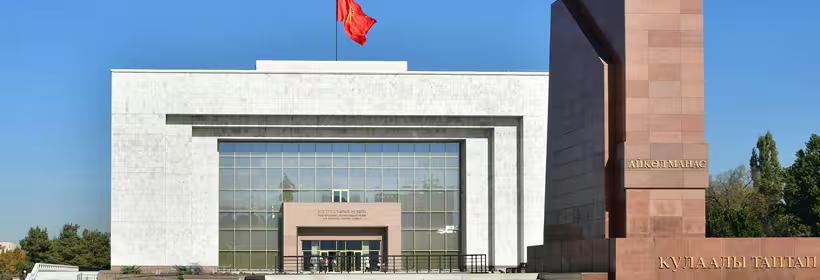
Ala Too Square in Bishkek, beneath the wall of the Tien Shan mountains
Nomads and Eagle Hunters
Today you reach the shores of Lake Issyk Kul, a vast expanse of deep blue water cradled high among the mountains. It is the second largest saline lake in the world after the Caspian Sea and the second largest mountain lake anywhere after Lake Titicaca. A faint saltiness and its great depth mean it almost never freezes, even in the depths of a Central Asian winter, which gives it its name, the warm lake.
Here you are welcomed to a nomadic festival that brings the old traditions of the steppe vividly to life. You watch spirited horseback games and wrestling, and meet the berkutchi, the eagle hunters who still ride out with magnificent golden eagles perched on their arms, a skill passed down through many generations. There is also the option to visit the nearby open air Museum of Petroglyphs, where boulders scattered across the grassland are carved with images left by hunters thousands of years ago.
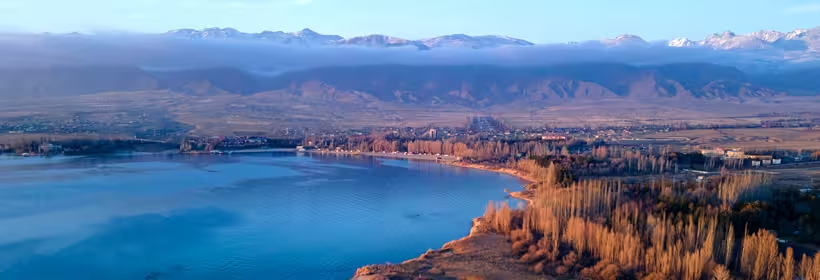
The beautiful Lake Issyk Kul, Kyrgyzstan
East Across the Border
A morning tour introduces you to Almaty, the largest city in Kazakhstan and its capital until the seat of government moved north to Astana in 1997. Set against a dramatic backdrop of snow capped peaks, this is a green and sophisticated city that famously gives its name to the apple, whose wild ancestor grows in the surrounding hills.
You visit leafy Panfilov Park and the wonderful Zenkov Cathedral within it, a soaring Russian Orthodox church built entirely of wood between 1904 and 1907 and one of the tallest wooden buildings in the world. You also see Independence Square and its monument before, in the afternoon, the whole group boards a private flight across the mountains into China, landing at Kashgar for an overnight stay in a comfortable five star hotel.
Oasis Market of the West
Kashgar, one of the westernmost cities of China, has been a great meeting point of trade and cultures for some two thousand years. Standing where the northern and southern arms of the Silk Road came together at the foot of the Pamirs, it remains one of the most atmospheric places on the whole route, its Central Asian character still strong.
You visit the Afaq Khoja Mausoleum, a graceful tiled tomb from the seventeenth century that is among the holiest Islamic sites in the region, then lose yourself in the narrow lanes of the Old Town, where craftsmen work in tiny open shops and the traditional Gaotai houses cling to a bluff above the city. Later you board the Golden Eagle Silk Road Express, your home for the long run east across China, and settle in with a welcome dinner as the train pulls away.
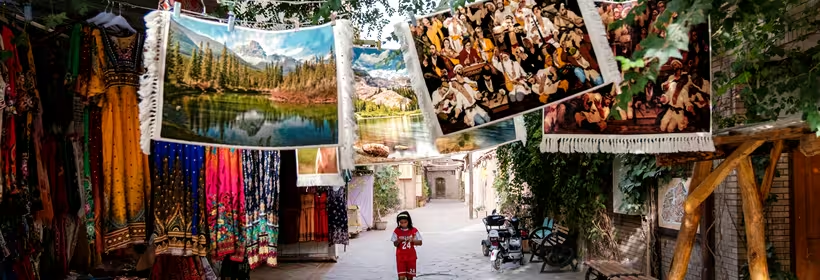
Kashgar, an ancient oasis city on the western edge of China
Silk, Carpets and Ancient Ruins
Hotan sits on the southern Silk Road at the edge of the fearsome Taklamakan Desert and has been prized for centuries for its jade, its carpets and its silk. You visit a workshop where atlas silk and hand knotted carpets are still made in the traditional way, the yarns coloured with natural dyes drawn from plants and minerals, and watch the weavers at their looms.
You also explore the ancient ruins of Yotkan, thought to be the site of the capital of the old kingdom of Khotan, a Buddhist realm that grew rich on the jade trade long before these lands became part of China. It is a quiet, evocative place that rewards the imagination.
Across the High Plateau
Today the railway climbs onto the vast, thin aired Qinghai plateau, one of the highest inhabited regions on earth, and reaches the frontier city of Golmud. Over a relaxed lecture you gain a deeper understanding of the history of the Silk Road and the part these remote lands played in linking East and West.
In the afternoon there is a choice of excursions. You may head out to the immense Chaerhan Salt Lake, the largest salt lake in China, a glittering white expanse so vast that a road and railway run straight across its crust, or you can take a guided tour of Golmud itself. Either way, the sheer scale and emptiness of the landscape here is unlike anything else on the journey.
Caves, Camels and Crescent Dunes
This is one of the great days of the whole expedition. Dunhuang was a key garrison and market town on the Silk Road, and just outside it lie the astonishing Mogao Caves, a UNESCO World Heritage Site often called the Cave of a Thousand Buddhas. Cut into a desert cliff, some four hundred and ninety surviving grottoes are filled with Buddhist murals and statues created across a thousand years, from the fourth century to the fourteenth, forming one of the richest treasuries of Buddhist art in existence.
The day holds simpler pleasures too. You enjoy a performance by local folk artists, then ride a camel along the old caravan trail into the dunes, just as merchants did for centuries. Finally you visit the enchanting Crescent Lake, a curved sliver of spring water that has survived for ages amid the towering Singing Sand dunes of Mingsha Shan, so named for the sound the sand makes as it shifts in the wind.
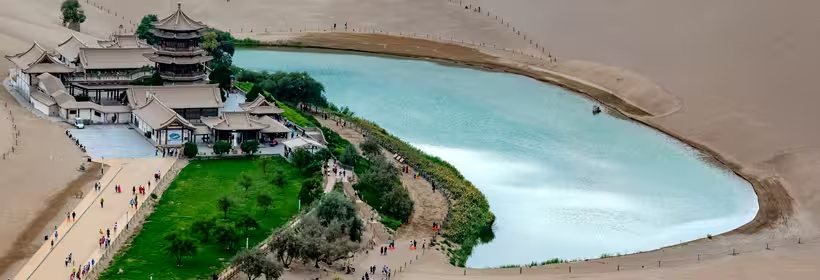
Crescent Lake, a spring fed oasis among the Singing Sand dunes at Dunhuang
Life on the Silk Road Express
After so many rich days of discovery, today is a chance to simply be still and enjoy the train itself. Settle into the panoramic observation car and watch the great sweep of China roll past, from desert margins to green farmland and busy rivers, or curl up in the lounge with a book and a pot of tea.
This is the rhythm that makes travel by private train so special. There are no bags to pack, no queues to join and nowhere you need to be, only the gentle motion of the carriage and the attentive care of the staff, who are on hand with fine wines, expertly mixed cocktails and good conversation whenever you wish.
The Terracotta Army
Xian, known in ancient times as Chang'an, was the eastern anchor of the Silk Road and for centuries one of the greatest cities in the world. You walk atop its formidable city walls, among the most complete in China and dating in their present form from the Ming dynasty in the thirteen hundreds, and visit the tranquil Great Mosque, a beautiful blend of Chinese and Islamic design that has served the city's Muslim community for centuries.
The undisputed highlight lies a short way out of town. In 1974 farmers digging a well stumbled upon the Terracotta Army, an underground host of an estimated eight thousand life sized soldiers, each with individual features, set to guard the tomb of Qin Shi Huang, the first emperor of a unified China. To stand before these silent ranks is one of the unforgettable sights of any journey. The day closes with a lavish banquet and a performance of music and dance in the style of the golden Tang dynasty.
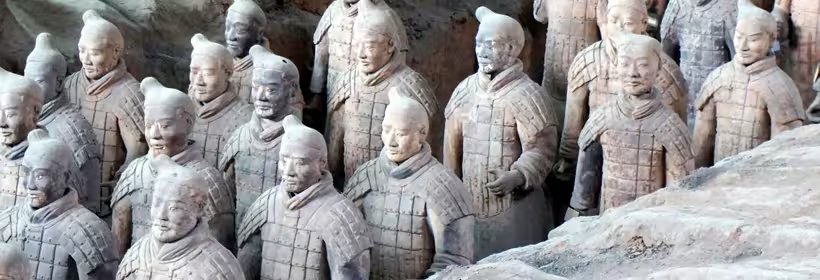
The Terracotta Army near Xian, guardians of China's first emperor
The Forbidden City
Arrive in Beijing, the mighty capital of China, and give yourself to its grand imperial heart. You tour the Forbidden City, the immense palace complex built between 1406 and 1420 for the emperors of the Ming dynasty, whose golden roofed halls and vast courtyards were closed to ordinary people for five hundred years. Nearby you take in the sweep of Tiananmen Square and, later, the graceful lake and pavilions of the Summer Palace, a favourite retreat of the imperial court.
You then check in to a landmark five star hotel for a two night stay in the centre of the city. For those who prefer a more modern face of Beijing, there is the alternative of visiting the Olympic Village with its famous Bird's Nest Stadium, the striking CCTV Tower and the National Museum.
The Great Wall of China
This morning brings a fitting climax to your Silk Road odyssey. You travel out to the Great Wall at Badaling, the most famous and beautifully restored section within easy reach of the capital, and walk a stretch of its ramparts as they climb and dip along the mountain ridges towards the horizon. Few sights in the world so perfectly reward the effort of reaching them.
The afternoon is yours to relax, to shop for last mementoes or simply to reflect on all you have seen. In the evening the group gathers one final time for a farewell dinner of Peking duck, the crisp skin carved at your table in the time honoured way, a celebratory end to an epic shared adventure.
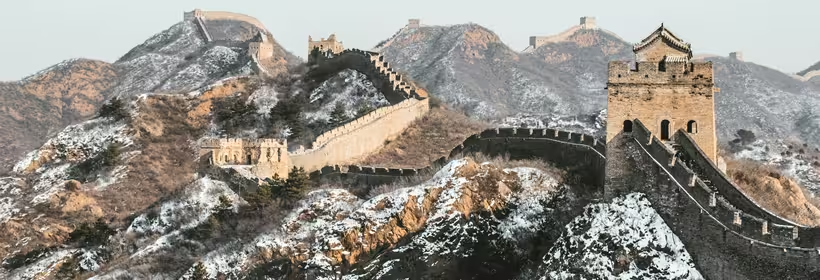
The Great Wall at Badaling, a fitting finale to a journey across a continent
Farewell
After a leisurely breakfast you are transferred to Beijing international airport in good time for your onward flight. You leave carrying the memory of a whole continent crossed and the world's greatest trading route travelled from end to end, in comfort, in company and in the finest of style.
Your Trains and Cabins
This journey is served by two of the Golden Eagle fleet. You spend eleven nights aboard the Golden Eagle across Central Asia and a further six nights aboard the Golden Eagle Silk Road Express as you travel through China. Both trains offer the same hallmark of relaxed elegance, with private en suite cabins, a pair of restaurant cars and a convivial bar lounge where a resident pianist plays into the evening.
Cabins come in three levels of comfort, each with its own washroom, individual climate control and the attentive care of a dedicated cabin attendant who prepares your bed each night. Whichever you choose, you enjoy the same fine dining, the same guided touring and the same warmth of service.
Gold Class
Beautifully appointed cabins with a lower and upper berth or twin layout, a private washroom and generous storage.
Imperial Suite
More spacious suites with additional comforts, ideal for those who like a little more room to spread out.
Han Dynasty Suite
The most generous accommodation on the train, offering the highest level of space, comfort and service.
Restaurant and Bar Cars
Two dining cars serve freshly prepared meals, while the bar lounge is the social heart of the train.
Dining on Board
Food is one of the great pleasures of this journey. Each day brings breakfast, lunch and dinner, freshly prepared on board using local produce gathered along the route. Menus weave together the flavours of the countries you pass through, from Central Asian plov to the regional cuisines of China, all served with fine wines and inclusive bar drinks.
Some meals are taken off the train too, from a platform barbecue beneath the stars at Bukhara to a Tang dynasty banquet at Xian and a farewell feast of Peking duck in Beijing. Special dietary requirements are looked after with care when arranged in advance.
What Is Included
This is a fully inclusive journey. Once you have arrived, almost everything is taken care of.
Accommodation
Eleven nights on the Golden Eagle, six nights on the Silk Road Express and several nights in five star hotels at either end of the route.
All Dining
Breakfast, lunch and dinner every day, prepared with local ingredients, with inclusive wines and bar beverages.
Guided Excursions
Every tour and cultural experience with expert tour managers and knowledgeable local guides.
Cabin Attendant
A dedicated attendant for your carriage, with nightly turndown and thoughtful personal service.
Onboard Doctor
A doctor travels with the train throughout for your reassurance and wellbeing.
Transfers and Porterage
All transfers, luggage handling and gratuities are included from start to finish.
Fares and Departures
Prices are per person in pounds sterling and include the full programme described above. The featured departure travels from 30 August to 22 September 2027. The 2028 departure travels from 30 August to 23 September 2028, a day longer at 25 days and 24 nights.
Fares 2027
| Cabin Class | Twin or Double, per person | Single Occupancy |
|---|---|---|
| Gold Class | £39,400 | £65,500 |
| Imperial Suite | £55,000 | £92,000 |
| Han Dynasty Suite | £80,600 | £161,200 |
Departure Dates 2027
| Departure | Return | Route |
|---|---|---|
| 30 August 2027 | 22 September 2027 | Tashkent to Beijing |
Fares 2028
| Cabin Class | Twin or Double, per person | Single Occupancy |
|---|---|---|
| Gold Class | £39,450 | £65,500 |
| Imperial Suite | £55,050 | £92,000 |
| Han Dynasty Suite | On request | On request |
Departure Dates 2028
| Departure | Return | Route |
|---|---|---|
| 30 August 2028 | 23 September 2028 | Tashkent to Beijing |
A deposit of 25 percent secures your place, with the balance due before departure. Fares are subject to availability and confirmation at the time of booking. Please contact our team for the latest prices and to reserve your cabin.
Frequently Asked Questions
The journey lasts twenty two days from Tashkent to Beijing. It combines eleven nights aboard the Golden Eagle, six nights aboard the Golden Eagle Silk Road Express and several nights in five star hotels.
You travel through five countries: Uzbekistan, Tajikistan, Kyrgyzstan, Kazakhstan and China, following the historic Silk Road from Central Asia into the heart of China.
The featured departure runs from 30 August to 22 September 2027. The 2028 departure runs from 30 August to 23 September 2028 and is a day longer at 25 days. Please contact us to confirm availability and to ask about any further dates.
Fares are shown per person in pounds sterling and vary by cabin class. Current prices are available on request, so please call our team for a tailored quotation.
Yes. Single occupancy cabins are available, and the sociable nature of the train makes it a wonderful choice for those travelling on their own.
Almost everything once you arrive: all accommodation, all meals with wines and bar drinks, every guided excursion, transfers, porterage, gratuities and an onboard doctor. Please ask us about international flights and visas.