Few corners of Europe reward the traveller quite like the old cities of the centre and east, where empires met and parted, and where beauty and history sit close together at every turn. This twelve-day journey by private train draws a line across them, from the Danube to the Baltic and back to the heart of the Habsburg lands.
Beginning in Budapest and ending in Vienna, the Golden Eagle Danube Express carries you through five countries and some of the most storied cities in Europe. There is the royal grandeur of Krakow and the salt cathedrals of Wieliczka; Warsaw, rebuilt from the ashes of war, and its beloved Chopin; the Gothic might of Malbork Castle and the maritime spirit of Gdansk; Berlin and Dresden, Prague and Salzburg, each with its own story to tell. It is a journey that does not shy away from the more sombre chapters either, with a reflective visit to Auschwitz-Birkenau among its most affecting moments.
Everything is arranged and included, from the excursions and entrance fees to the meals, the drinks and the gratuities. Two nights in a five-star Budapest hotel and a final night in Vienna frame eight nights aboard the private train, with expert local guides at every stop and a tour management team and doctor travelling with you throughout.
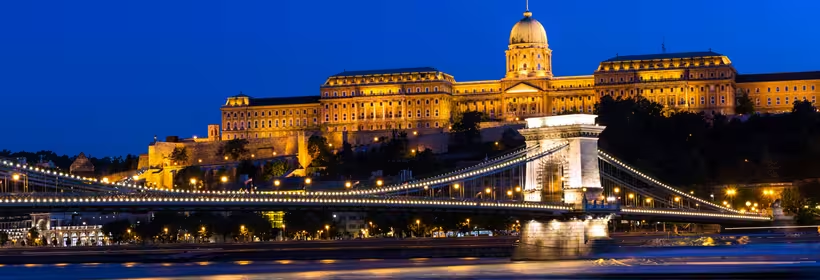
Budapest on the Danube, where the journey begins
Journey Highlights
Auschwitz-Birkenau
A guided visit to the UNESCO-listed memorial and museum, a moving and reflective morning at one of the most significant sites of the 20th century.
Kraków & the Salt Mine
The royal old town of Krakow and the astonishing Wieliczka Salt Mine, with its chapels, chandeliers and sculptures all carved from rock salt.
Warsaw & Chopin
Warsaw's rebuilt old town and the POLIN museum of Polish Jewish history, followed by a private recital of Chopin in a fitting historic setting.
Malbork Castle & Gdansk
The largest brick castle in the world, seat of the Teutonic Knights, and the Baltic port of Gdansk, birthplace of the Solidarity movement.
Berlin by Trabant
See Berlin's landmarks from behind the wheel of a classic East German Trabant, from the East Side Gallery to Karl-Marx-Allee.
Salzburg & the Semmering
Mozart's Salzburg and the trick fountains of Hellbrunn, then the UNESCO-listed Semmering Pass, the world's first mountain railway.
Day-by-Day Itinerary
Timings are indicative; confirmed details are supplied with your travel documents.
Arrival in Budapest
Arrive in Budapest and transfer to the five-star Four Seasons Hotel Gresham Palace, a restored Art Nouveau landmark on the Pest embankment, facing the Chain Bridge and Buda Castle across the Danube. This evening, gather for a welcome reception and dinner with panoramic river views, and meet your Tour Manager and fellow travellers.
Budapest is really twin cities married across the Danube: hilly, historic Buda on the west bank, where the Romans built their garrison town of Aquincum, and flat, bustling Pest on the east, laid out in grand style when the two were formally united in 1873. For half a century it was a co-capital of the Austro-Hungarian Empire, and the boulevards, bridges and coffee houses of that golden age still give the city its swagger. It sits atop more than a hundred thermal springs too, which have made it a city of grand bath houses since Ottoman times.
Welcome reception dinner. Two hotel nights at the Four Seasons Gresham Palace, Budapest.
Imperial Budapest
A panoramic tour takes in the highlights of the Hungarian capital: the Castle District with St Matthias Church and the Fishermen's Bastion on the Buda hills, and the neo-Gothic Parliament on the Pest bank. A private visit to the sumptuous Hungarian State Opera House, with a drinks reception, rounds out the morning.
The afternoon is free to enjoy the city at your own pace, whether a stroll along the Danube or a soak in one of Budapest's grand thermal baths.
Panoramic city tour; Parliament and private Opera House visit; afternoon at leisure.
All Aboard the Danube Express
The morning is at leisure before you transfer to Budapest's Nyugati station, where a drinks reception in the historic Royal Waiting Room precedes boarding the Golden Eagle Danube Express. A private brass band plays as the train pulls away, and a welcome dinner is served on board as you settle into your cabin for the first night's travel north towards Poland.
First night on board. Royal Waiting Room reception; welcome dinner on board.
Kraków and Auschwitz-Birkenau
This morning brings a guided visit to Auschwitz-Birkenau, the UNESCO-listed memorial and museum on the site of the former concentration camp, a sombre and deeply moving experience that stays long in the memory. Those who would prefer not to take part may instead choose a walking tour of Krakow's old town, Wawel Royal Castle and the Jewish Quarter.
After lunch in Krakow's beautiful old town, one of the first sites ever added to the UNESCO World Heritage list, there is a visit to the extraordinary Wieliczka Salt Mine, where centuries of miners carved chapels, chandeliers and statues entirely from rock salt deep underground.
Krakow was the royal capital of Poland for half a millennium, and unlike so many Polish cities it came through the war almost unscathed, leaving its medieval and renaissance heart intact. At its centre lies one of the largest market squares in Europe, watched over by the twin towers of St Mary's Basilica, from which a trumpeter still sounds the hourly call, while above the Vistula rises Wawel, the castle and cathedral of Poland's kings. The salt mine at nearby Wieliczka has been worked for some seven hundred years, its miners carving an entire underground world from the living rock.
Auschwitz-Birkenau guided visit, or Krakow walking tour; Krakow old town; Wieliczka Salt Mine.
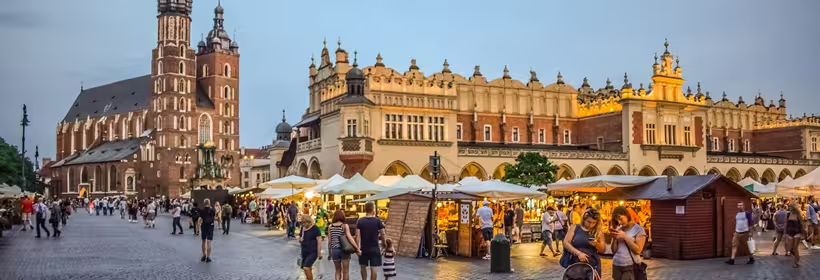
The market square of Kraków, among the first UNESCO World Heritage Sites
Warsaw and a Chopin Recital
A guided tour of Warsaw follows the Royal Route through the old town, painstakingly rebuilt after the Second World War and now a UNESCO World Heritage Site, and passes through the area of the former Warsaw Ghetto. A visit to the acclaimed POLIN Museum tells the thousand-year story of Poland's Jews.
In the afternoon, a private recital brings the music of Fryderyk Chopin, Warsaw's most famous son, to life in a fitting historic setting, one of the highlights of any visit to the Polish capital.
No city better embodies Polish resilience than Warsaw. Reduced almost to rubble in the Second World War, its old town was rebuilt so faithfully, brick by brick and often from old paintings, that it too has earned a place on the UNESCO list. This was the city of Fryderyk Chopin, who grew up here before leaving for Paris at the age of twenty, and whose heart, at his own request, was brought back to Warsaw after his death and rests to this day in a pillar of the Holy Cross Church.
Warsaw old town and Royal Route; POLIN Museum; private Chopin recital.
Malbork Castle and Gdansk
The morning is spent at Malbork Castle, a UNESCO World Heritage Site and the largest brick castle in the world, built by the Teutonic Knights on the banks of the Nogat. The train then continues to Gdansk, with lunch served on board.
The afternoon explores the great Baltic port: the European Solidarity Centre, which tells the story of the movement that helped bring down the Iron Curtain, an organ concert at the soaring Oliwa Cathedral, and the handsome merchant houses of the Long Market.
Malbork was the mighty headquarters of the Teutonic Knights, the crusading order that ruled much of the Baltic in the Middle Ages, and its river-fortress remains the largest castle in the world by land area. Gdansk, once the Hanseatic port of Danzig, grew rich on grain and amber and wears that wealth in the tall, richly decorated facades of the Long Market. It was here, in the shipyards in 1980, that Lech Walesa and the Solidarity movement began the wave of protest that would in time help bring down communism across Eastern Europe.
Malbork Castle; lunch on board; European Solidarity Centre; Oliwa Cathedral organ concert; the Long Market.
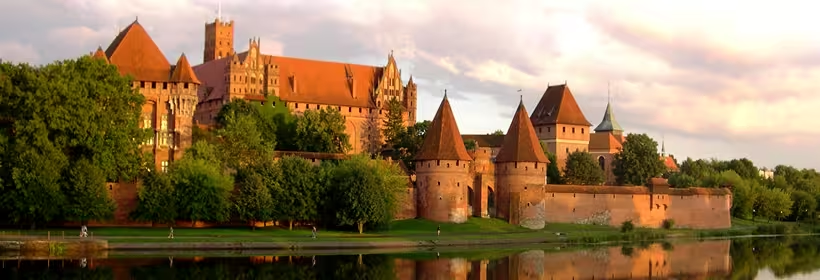
Malbork Castle, the great fortress of the Teutonic Knights
Berlin, East and West
A full day in the German capital comes with a Freedom of Choice. The most memorable option puts you behind the wheel of a classic VEB Trabant for a guided convoy past the landmarks of the divided city, from Karl-Marx-Allee and the East Side Gallery to the Oberbaum Bridge.
Alternatively, explore at leisure, with time for the Checkpoint Charlie Museum, the great collections of Museum Island, another UNESCO World Heritage Site, or the shops of the Kurfürstendamm.
No city tells the story of the twentieth century quite like Berlin. Capital of Prussia and then of a unified Germany, it was left divided in two by the Cold War, its people separated for twenty-eight years by the notorious Wall until it fell, joyfully, in 1989. Today the line of that division has become a place of memory and art, from the painted remnants of the East Side Gallery to the old crossing at Checkpoint Charlie, and the little Trabant, once the everyday car of the East, has become an unlikely and much-loved emblem of the vanished world beyond the Wall.
Freedom of Choice: Trabant driving experience, or Berlin at leisure with Museum Island and Checkpoint Charlie.
Dresden and on to Prague
The morning is spent in Dresden, the baroque capital of Saxony reborn from the destruction of the war. A city tour takes in the magnificently restored Frauenkirche, the Church of Our Lady, and Dresden Castle, with the chance of refreshment at the elegant Taschenbergpalais.
By late afternoon the train reaches Prague, where the evening brings a visit to the Art Nouveau Municipal House for an operatic performance and dinner in one of the city's most beautiful interiors.
Dresden was once known as the Florence of the Elbe, a city of baroque palaces, churches and art collections amassed by the electors of Saxony. Almost all of it was destroyed in the firestorm of February 1945, and its rebuilding has been one of Europe's great acts of restoration, crowned by the Frauenkirche, painstakingly reassembled from thousands of numbered original stones and finally reconsecrated in 2005 as a symbol of reconciliation.
Dresden city tour and Frauenkirche; arrival in Prague; Municipal House opera performance and dinner.
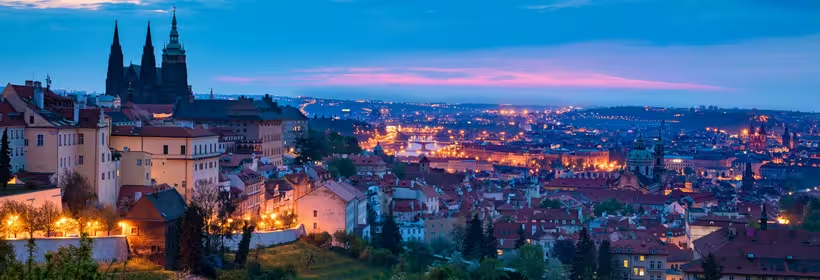
Prague, the City of a Hundred Spires
Prague Castle and the Old Town
A vintage tram carries the group up to Prague Castle, listed as the largest ancient castle complex in the world, and to the Gothic masterpiece of St Vitus Cathedral at its heart. After lunch, the afternoon is free to wander the Old Town Square, cross the Charles Bridge or simply take in one of the most beautiful capitals in Europe before returning to the train.
Prague came through the war and the centuries with a completeness few European capitals can match, a thousand years of Romanesque, Gothic, baroque and Art Nouveau piled up along the winding Vltava. It reached its zenith under Charles IV, the Bohemian king and Holy Roman Emperor who founded its university and raised the great stone bridge that still bears his name. More recently it gave the world the Velvet Revolution of 1989, when the crowds on Wenceslas Square brought down communism without a shot fired.
Vintage tram to Prague Castle and St Vitus Cathedral; lunch; afternoon at leisure.
Mozart's Salzburg
The birthplace of Mozart and a setting for The Sound of Music, Salzburg is one of the loveliest cities in the Alps. You visit the Mirabell Palace and its formal gardens, a UNESCO World Heritage Site, the Mozart Residence on Makartplatz, and the famous Getreidegasse with its wrought-iron shop signs.
In the afternoon, a visit to Hellbrunn Palace reveals its celebrated Wasserspiele, the playful trick fountains laid out by a prince-archbishop four centuries ago to surprise his guests.
Salzburg owes its name and its fortune to salt, the white gold mined in the surrounding mountains that once made its prince-archbishops among the wealthiest rulers in the Alps. They spent that wealth on the domes and squares of a jewel-box baroque city, and into it, in 1756, was born Wolfgang Amadeus Mozart. Two centuries later the hills above the town provided the backdrop for The Sound of Music, and the city has become one great stage for music, crowned each summer by its celebrated festival.
Mirabell Palace and gardens; Mozart Residence; Getreidegasse; Hellbrunn Palace and trick fountains.
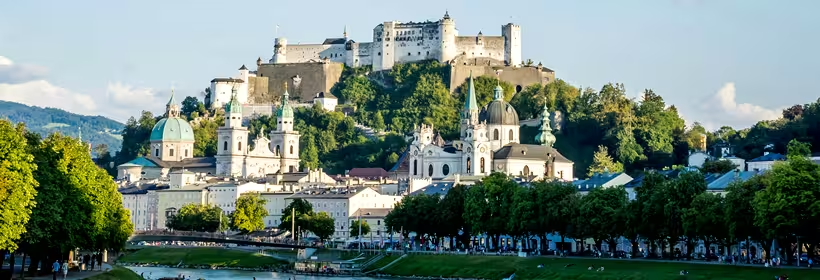
Salzburg, the birthplace of Mozart in the Austrian Alps
The Semmering Pass and Imperial Vienna
Leaving Salzburg, the train makes one of Europe's great rail crossings: the Semmering Pass, the world's first true mountain railway, opened in 1854 and carried across the Alps on soaring viaducts and through a series of tunnels. You arrive in Vienna around lunchtime.
The afternoon brings a private concert by the Vienna Supreme Orchestra and a visit to the imperial Schönbrunn Palace, or time to explore the city at leisure. This evening you check in to the five-star Ritz-Carlton, set in a row of restored 19th-century palaces on the Ringstrasse, for a celebratory farewell dinner.
For six centuries Vienna was the seat of the Habsburgs and the capital of an empire that stretched across much of Europe, and imperial grandeur is written across the whole city, from the palaces of the Hofburg and Schönbrunn to the monumental sweep of the Ringstrasse. It was the Vienna of Mozart, Beethoven, Brahms and the waltzing Strauss dynasty, and of the coffee houses where writers and thinkers idled away the afternoons, a refined and unhurried way of life the city guards to this day.
Semmering Pass crossing; Vienna Supreme Orchestra concert and Schönbrunn Palace; farewell dinner. One hotel night at the Ritz-Carlton, Vienna.
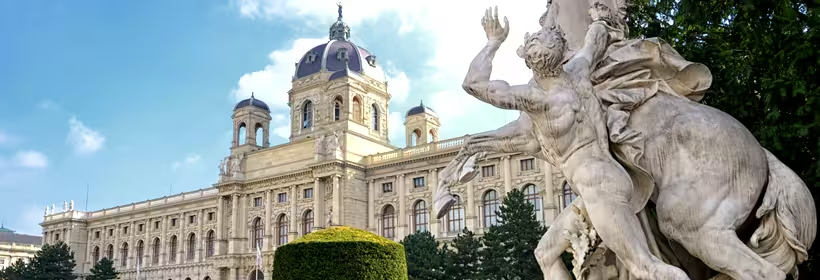
Imperial Vienna, where the journey comes to a close
Onward Journey
After breakfast, a private transfer takes you to the airport for your onward journey home. Should you wish to linger, an extended stay in Vienna can be arranged, adding time to enjoy the coffee houses, museums and imperial grandeur of the Austrian capital.
Breakfast and private airport transfer. Optional extension.
What's Included
Accommodation
2 nights five-star at the Four Seasons Gresham Palace, Budapest, 8 nights aboard the Danube Express and 1 night at the Ritz-Carlton, Vienna.
All Dining
Breakfasts, lunches and dinners throughout, freshly prepared on board and at selected venues, with inclusive alcoholic and non-alcoholic beverages.
Excursions & Entrance Fees
Every guided excursion in the itinerary, all entrance fees, the Freedom of Choice options and expert local guides at each stop.
Service & Care
Cabin attendant with evening turndown, an experienced Tour Management team and a UK-registered doctor with medical facilities on board.
Transfers & Gratuities
Arrival and departure transfers, luggage porterage throughout, and all gratuities on and off the train.
The Danube Express
Eight nights aboard the boutique private train, with its en-suite cabins, elegant restaurant car and convivial bar-lounge car.
Fares 2027
Prices are per person and include the full programme detailed above, all excursions and entrance fees. A deposit of 25% of the tour cost secures your booking. Please call us on 0333 405 0192 for confirmed fares.
| Cabin Class | Twin (per person) from | Single (per person) from |
|---|---|---|
| Deluxe Class | £19,400 | £29,000 |
| Superior Deluxe Class | £24,700 | £41,200 |
Departure Dates 2027
| Departure | Return | Route |
|---|---|---|
| 7 June 2027 | 18 June 2027 | Budapest to Vienna |
Fares 2028
| Cabin Class | Twin (per person) from | Single (per person) from |
|---|---|---|
| Deluxe Class | £20,400 | £30,500 |
| Superior Deluxe Class | £25,950 | £43,300 |
Departure Dates 2028
| Departure | Return | Route |
|---|---|---|
| 9 June 2028 | 20 June 2028 | Budapest to Vienna |
Frequently Asked Questions
Twelve days and eleven nights, travelling one way from Budapest to Vienna through five countries: Hungary, Poland, Germany, the Czech Republic and Austria. It takes in Krakow, Warsaw, Malbork, Gdansk, Berlin, Dresden, Prague and Salzburg, with two hotel nights in Budapest and one in Vienna framing eight nights aboard the train.
A guided visit to Auschwitz-Birkenau, the Wieliczka Salt Mine, a private Chopin recital in Warsaw, Malbork Castle, Gdansk and the Solidarity story, Berlin by classic Trabant, Dresden's Frauenkirche, Prague Castle, and Salzburg's Mirabell and Hellbrunn palaces, among many others.
The journey is aboard the Golden Eagle Danube Express, a boutique private train with en-suite Deluxe and Superior Deluxe cabins. You can read more on our Danube Express train page.
The 2027 departure runs from 7 to 18 June and the 2028 departure from 9 to 20 June. Please contact us for the confirmed departures and current fares.
All accommodation, meals on board and at selected venues with inclusive drinks, every guided excursion and entrance fee, all transfers, gratuities and luggage porterage, plus a tour management team, local guides and a UK-registered doctor. International flights are not included.
The guided visit to Auschwitz-Birkenau is part of the Day 4 programme, a moving and reflective morning. Those who would prefer not to take part may instead choose a guided walking tour of Krakow's old town, Wawel Royal Castle and the Jewish Quarter.